


Page 131 - IJOCTA-15-4
P. 131
Fixed-time sliding mode control with disturbance observer and variable exponent coefficient for nonlinear
                                                         systems
                Remark 1.     Unlike global fixed-time sta-
            bility, practical fixed-time stability implies con-
            vergence of tracking errors to a specific re-
            gion around the origin rather than to the ex-
            act origin. This concept is often more applica-
            ble to real-world scenarios, such as motors and
            robotic manipulator systems, 42,43  especially in
            controllers employing DOs or adaptive approxi-
            mators.
                To better understand system stability, we re-
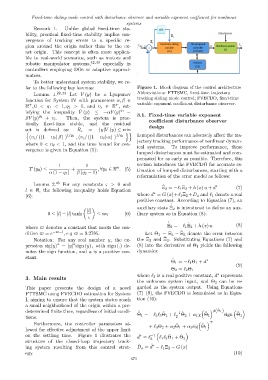
            fer to the following key lemmas:                  Figure 1. Block diagram of the control architecture
                Lemma 1.  22,44  Let V (y) be a Lyapunov      Abbreviations: FTTSMC, fixed-time trajectory
                                                              tracking sliding mode control; FVECDO, fixed-time
            function for System IV with parameters α, β ∈
                                                    +
              +
            ℜ , 0 < q 1 < 1, q 2 > 1, and υ ι ∈ ℜ , sat-      variable exponent coefficient disturbance observer.
                                     ˙
            isfying the inequality V (y) ≤ −αV (y)     q 1  −
            βV (y) q 2  + υ ι .  Then, the system is prac-    3.1. Fixed-time variable exponent
                                                                   coefficient disturbance observer
            tically fixed-time stable,   and the residual
                                                                   design
            set is defined as:     R ι  =    {y|V (y) ≤ min
             n                                           oo
              (υ ι / ((1 − υ θ ) β) ) 1/q 2  , (υ ι / ((1 − υ θ ) α) ) 1/q 1  Lumped disturbances can adversely affect the tra-
                                                              jectory tracking performance of nonlinear dynam-
            where 0 < υ θ < 1, and the time bound for con-
                                                              ical systems.  To improve performance, these
            vergence is given in Equation (5):
                                                              lumped disturbances must be estimated and com-
                                                              pensated for as early as possible. Therefore, this
                           1           1                      section introduces the FVECDO for accurate es-
                                                     n
              T (y 0 ) ≤         +          , ∀y 0 ∈ ℜ . (5)  timation of lumped disturbances, starting with a
                       α (1 − q 1 )  β (q 2 − 1)
                                                              reformulation of the error model as follows:
                Lemma 2.  45  For any constants ς > 0 and                ˙                       ∗
            l ∈ ℜ, the following inequality holds Equation           ∗   Ξ 2 = −ℓ 1 Ξ 2 + h (x) u + d     (7)
            (6):                                              where d = G (x)+ℓ 1 Ξ 2 +D a and ℓ 1 denote a real
                                                              positive constant. According to Equation (7), an
                                                                             ˙
                                                                             ˆ
                                                              auxiliary state Ξ 2 is introduced to define an aux-
                                        |l|

                      0 ≤ |l| − |l| tanh    ≤ ϖς        (6)   iliary system as in Equation (8):
                                        ς
                                                                            ˙
                                                                           ˆ
                                                                                    ˆ
            where ϖ denotes a constant that meets the con-                 Ξ 2 = −ℓ 1 Ξ 2 + h (x) u       (8)
                                                                                 ˆ
            dition ϖ = e −ϖ−1 , e.g ϖ = 0.2785.                   Let Θ 1 = Ξ 2 − Ξ 2 denote the error between
                                                                          ˆ
                Notation: For any real number y, the ex-      the Ξ 2 and Ξ 2 . Substituting Equations (7) and
                                  a
                          a
            pression sig(y) = |y| sign (y) , with sign (.) de-  (8) into the derivative of Θ 1 yields the following
            notes the sign function, and a is a positive con-  dynamics:
            stant.
                                                                              ˙
                                                                             Θ 1 = −ℓ 1 Θ 1 + d ∗
                                                                                                          (9)
                                                                             Θ 2 = ℓ 2 Θ 1
                                                                                                  ∗
                                                              where ℓ 2 is a real positive constant, d represents
            3. Main results
                                                              the unknown system input, and Θ 2 can be re-
            This paper presents the design of a novel         garded as the system output. Using Equations
            FTTSMC using FVECDO estimation for System         (7)–(9), the FVECDO is formulated as in Equa-
            I, aiming to ensure that the system states reach  tion (10):
            a small neighborhood of the origin within a pre-
                                                                                                  ˜
            determined finite time, regardless of initial condi-  ˆ      ˆ     −1 ˙        ˜   ϕ(Θ 1)    ˜
                                                              ˙
            tions.                                            Θ 1 = −ℓ 2 ℓ 3 Θ 1 + ℓ 2  Θ 2 + α 1 χ Θ 1  sign Θ 1
                Furthermore, the controller parameters al-                     ˜          ˜   Υ
                                                                   + ℓ 3 Θ 2 + α 2 Θ 1 + α 3 sig Θ 1
            lowed for effective adjustment of the upper limit

            on the settling time.   Figure 1 illustrates the  d = ℓ −1  ℓ 1 ℓ 2 Θ 1 + Θ 2
                                                              ˆ ∗
                                                                                 ˙
                                                                            ˆ
            structure of the closed-loop trajectory track-          2
                                                              ˆ
                                                                    ˆ ∗
            ing system resulting from this control strat-     D a = d − ℓ 1 Ξ 2 − G (x)
            egy.                                                                                         (10)
                                                           673

