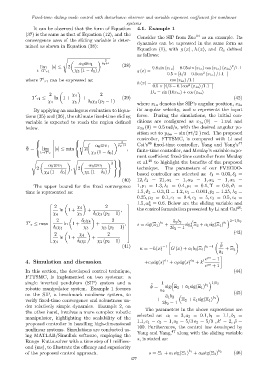
Page 135 - IJOCTA-15-4
P. 135

Fixed-time sliding mode control with disturbance observer and variable exponent coefficient for nonlinear
                                                         systems
                It can be observed that the form of Equation  4.1. Example 1
            (37) is the same as that of Equation (12), and the                          14
                                                              Consider the SIP from Zuo    as an example. Its
            convergence area of the sliding variable is deter-
                                                              dynamics can be expressed in the same form as
            mined as shown in Equation (38):
                                                              Equation (1), with g (x) , h (x), and D a defined
                                                              as follows:
                             s
                                                2

                                    α 6 ϖυ 1  p 2 +1
                   lim |s| ≤   2                       (38)          9.8 sin (x 1a ) − 0.05 sin (x 1a ) cos (x 1a ) (x 2a ) /1.1
                                                                                                        2
                     ′            χ 3 (1 − δ 0 )
                  t→T r1                                      g (x) =
                                                                                           2
                                                                           0.5 × [4/3 − 0.1cos (x 1a ) /1.1 ]
                    ′
            where T r1 can be expressed as:                                  cos (x 1a ) /1.1
                                                              h (x) =
                                                                                     2
                                                                     0.5 × [4/3 − 0.1cos (x 1a ) /1.1 ]
                                                                  D a = sin (10x 1a ) + cos (x 2a )
                       2         χ 4          2
                 ′
               T r1 ≤    ln 1 +       +                (39)                                              (42)
                      χ 4        χ 5    δ 0 χ 3 (p 2 − 1)
                                                              where x 1a denotes the SIP’s angular position, x 2a
                By applying an analogous evaluation to Equa-  its angular velocity, and u represents the input
            tions (35) and (36), the ultimate fixed-time sliding  force.  During the simulations, the initial con-
            variable is expected to reach the region defined  ditions are configured as x 1a (0) = 1 rad and
            below.                                            x 2a (0) = 0.5 rad/s, with the desired angular po-
                                                              sition set to y des = sin (πt/2 ) rad. The proposed
                                                              controller, FTTSMC, is compared with Li and
                                s
                                                       2
                                                                46                                      47
                                                    p 2 +1  Cai’s  fixed-time controller, Yang and Yang’s
                                          α 6 ϖυ 1
            Φ =     lim   |s| ≤ min  2                  ,    finite-time controller, and Moulay’s variable expo-
                      ′                 χ 3 (1 − δ 0 )
                                  
                                                              nent coefficient fixed-time controller from Moulay
                 t→T r
                                                   
                                 s
               s                                                   48
                                                          et al.  to highlight the benefits of the proposed
                                                  2
                      α 6 ϖυ 1          α 6 ϖυ 1
                 2              ,   2                         technique.  The parameters of our FVECDO-
                     χ 4 (1 − δ 0 )    χ 5 (1 − δ 0 )
                                                              based controller are selected as: ℓ 1 = 0.03, ℓ 2 =
                                                   
                                                       (40)   12, ℓ 3 = 21, α 1 = 1, α 2 = 1, α 3 = 1, α 5 =
                The upper bound for the fixed convergence     1, p 1 = 1.3, λ 1 = 0.4, µ 1 = 0.1, Υ = 0.6, ϑ 1 =
            time is represented as:                           1.5, ϑ 2 = 0.3, Ω = 1.2, υ 1 = 0.001, p 2 = 1.25, λ 2 =
                                                              0.25, µ 2 = 0.1, c 1 = 0.4, c 2 = 5, c 3 = 0.5, c 4 =
                                                                   ∗
                                                              1.5, α = 0.6. Below are the sliding variable and

                         2         χ 4          2                                                         46
                                                                 6
                           ln 1 +       +              ,      the control formulation presented by Li and Cai :
                         χ 4       χ 5
                                         δ 0 χ 3 (p 2 − 1)  
                                                         
                                                        
                       
              ′         2           δ 0 χ 4       2                   b 1   ¯ a 2 b 2            b 1   2−1/b 2
            T r ≤ max       ln 1 +         +            ,   s = sig(Ξ 1 ) +      sig Ξ 2 + ¯a 1 sig(Ξ 1 )
                       δ 0 χ 4       χ 5     χ 3 (p 2 − 1)                 2b 2 − 1
                                                         
                                                                                                       (43)
                         2                       2
                                   χ 4                   
                           ln 1 +         +
                         χ 4       δ 0 χ 5  χ 3 (p 2 − 1)
                                                                                                 ¯
                                                       (41)              −1                 b 1 −1  ϕ
                                                               u = −h(x)     G (x) + ¯a 1 b 1 |Ξ 1 |  + Ξ 2
                                                                                                  ¯ a 1

            4. Simulation and discussion                         +c 1 sig(s) o 1  + c 2 sig(s) o 2  + k ′ e ¯ ρs  − 1
                                                                                            e ¯ ρs  + 1
            In this section, the developed control technique,                                            (44)
            FTTSMC, is implemented on two systems: a
            single inverted pendulum (SIP) system and a             ¯    1                 b 1   1/b 2
            robotic manipulator system. Example 1 focuses           ϕ =  ¯ a 2  sig Ξ 2 + ¯a 1 sig(Ξ 1 )
            on the SIP, a benchmark nonlinear system, to                  ¯ a 1 b 2                    (45)
            verify fixed-time convergence and robustness un-           +  2b 2 − 1  Ξ 2 + ¯a 1 sig(Ξ 1 ) b 1
            der relatively simple dynamics. Example 2, on
            the other hand, involves a more complex robotic       The parameters in the above expressions are
            manipulator, highlighting the scalability of the  selected as: ¯a 1 = 3, ¯a 2 = 0.1, b 1 = 1.1, b 2 =
                                                                                                   ′
                                                              1.1, c 1 = c 2 = 1, o 1 = 5/3 o 2 = 5/9 , k = 2, ¯ρ =
            proposed controller in handling high-dimensional
                                                              100. Furthermore, the control law developed by
            nonlinear systems. Simulations are conducted us-
                                                              Yang and Yang, 47  along with the sliding variable
            ing MATLAB/Simulink software, employing the
                                                              s, is stated as:
            Runge–Kutta solver with a time step of 1 millisec-
            ond (ms), to illustrate the efficacy and superiority
                                                                                     b 1
            of the proposed control approach.                      s = Ξ 1 + ¯a 1 sig(Ξ 1 ) + ¯a 2 sig(Ξ 2 ) b 2  (46)
                                                           677
   130   131   132   133   134   135   136   137   138   139   140