


Page 136 - IJOCTA-15-4
P. 136
Anjum et al. / IJOCTA, Vol.15, No.4, pp.670-685 (2025)


                     −1         1                b 1 −1   2−b 2
            u = −h(x)   G (x) −   sig Ξ 2 1 + ¯a 1 b 1 |Ξ 1 |
                               ¯ a 2 b 2
                     +c 1 sig(s) o 1  + c 2 sig(s) o 2  + k ′ e ¯ ρs  − 1
                                            e ¯ ρs  + 1
                                                       (47)

                The parameters in the above expressions are
            selected as follows:  ¯ a 1 = 5, ¯a 2 = 0.1, b 1 =
                                                        ′
            1.1, b 2 = 1.1, c 1 = c 2 = 1, o 1 = 5/3 ,o 2 = 5/9, k =
            2, ¯ρ = 100. The parameters for Moulay’s variable
            exponent coefficient fixed-time controller are set
            as in Moulay et al. 48  The angular position track-
            ing of the SIP and the angular position tracking
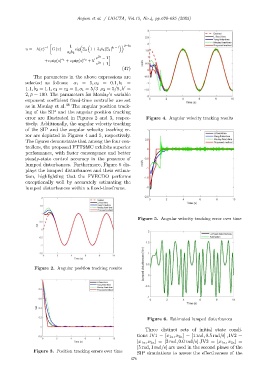
            error are illustrated in Figures 2 and 3, respec-     Figure 4. Angular velocity tracking results
            tively. Additionally, the angular velocity tracking
            of the SIP and the angular velocity tracking er-
            ror are depicted in Figures 4 and 5, respectively.
            The figures demonstrate that among the four con-
            trollers, the proposed FTTSMC exhibits superior
            performance, with faster convergence and better
            steady-state control accuracy in the presence of
            lumped disturbances. Furthermore, Figure 6 dis-
            plays the lumped disturbances and their estima-
            tion, highlighting that the FVECDO performs
            exceptionally well by accurately estimating the
            lumped disturbances within a fixed-timeframe.


                                                              Figure 5. Angular velocity tracking error over time


                Figure 2. Angular position tracking results


                                                                  Figure 6. Estimated lumped disturbances

                                                                  Three distinct sets of initial state condi-
                                                              tions IV1 = [x 1a , x 2a ] = [1 rad, 0.5 rad/s] , IV2 =
                                                              [x 1a , x 2a ] = [3 rad, 0.0 rad/s] ,IV3 = [x 1a , x 2a ] =
                                                              [5 rad, 1 rad/s] are used in the second phase of the
                Figure 3. Position tracking errors over time
                                                              SIP simulations to assess the effectiveness of the
                                                           678

