


Page 137 - IJOCTA-15-4
P. 137
Fixed-time sliding mode control with disturbance observer and variable exponent coefficient for nonlinear
                                                         systems
            proposed control approach under external distur-  the actuator inputs applied to the system. The
            bances and model uncertainties. The parameters    matrix Z ι (q ι , ˙q ι ) ∈ R n×n  accounts for centripetal
                                                                                              n
            of the FTTSMC scheme are tuned based on the       and Coriolis forces. G ι (q ) ∈ ℜ represents the
                                                                                       ι
                                                                                        n
            earlier analysis. Tracking errors for angular po-  gravity vector, and τ d ∈ ℜ indicates the exter-
            sition are shown in Figure 7, and tracking errors  nal disturbance matrix. Assume that the model
            for angular velocity under various initial condi-  parameters are expressed as M(q ι ) = M 0 (q ι ) +
            tions are shown in Figure 8. It is noteworthy that  ∆M(q ι ), Z ι (q ι , ˙q ι )  =  Z ι0 (q ι , ˙q ι ) + ∆Z ι (q ι , ˙q ι ),
            the convergence time remains unchanged regard-    and M(q ι ) = M 0 (q ι ) + ∆M(q ι ), Z ι (q ι , ˙q ι ) =
            less of the initial conditions, which reinforces the  Z ι0 (q ι , ˙q ι ) + ∆Z ι (q ι , ˙q ι ), G ι (q ι )  =  G ι0 (q ι ) +
            fixed-time attributes discussed in this study and  ∆G ι (q ι ),  represent  the   nominal    val-
            illustrates the practical utility of the fixed-time  ues.  ∆M(q ι ),  ∆Z ι (q ι , ˙q ι ),  ∆G ι (q ι ) and
            controller.                                       ∆M(q ι ), ∆Z ι (q ι , ˙q ι ), ∆G ι (q ι ) represent the un-
                                                              known components. The involved matrices are
                                                              defined as shown in Equation (49):


                                                                         m 11 m 12                z 11 z 12
                                                               M (q ) =             , Z ι (q ,˙q ) =       ,
                                                                                          ι
                                                                    ι
                                                                                            ι
                                                                         m 21 m 22                z 21 z 22
                                                                                T

                                                               G (q ) = g 1 g 2
                                                                   ι
                                                                                                         (49)
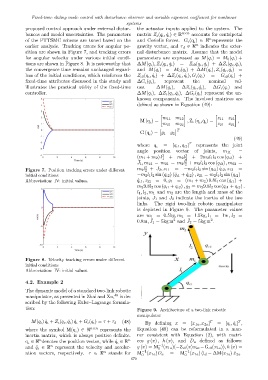
                                                              where q  ι  =   [q ι1 , q ι2 ] T  represents the joint
                                                              angle  position  vector  of  joints,  m 11   =
                                                              (m 1 + m 2 ) l 2  + m 2 l 2 2  + 2m 2 l 1 l 2 cos (q ι2 ) +
                                                                         1
                                                              ¯
                                                                                   2
                                                              J 1 , m 12 = m 21 = m 2 l + m 2 l 1 l 2 cos (q ι2 ) , m 22 =
                                                                                   2
                                                                  2    ¯       =                           =
            Figure 7. Position tracking errors under different  m 2 l + J 2 , z 11  −m 2 l 1 l 2 sin (q ι2 ) ˙q ι2 , z 12
                                                                 2
            initial conditions                                −m 2 l 1 l 2 sin (q ι2 ) ( ˙q ι1 + ˙q ι2 ) , z 21 = m 2 l 1 l 2 sin (q ι2 )
            Abbreviation: IV: initial values.                 ˙ q ι1 , z 22 = 0, g 1 = (m 1 + m 2 ) 9.8l 1 cos (q ι1 ) +
                                                              m 2 9.8l 2 cos (q ι1 + q ι2 ) , g 2 = m 2 9.8l 2 cos (q ι1 + q ι2 ) .
                                                              l 1 , l 2 , m 1 and m 2 are the length and mass of the
                                                                             ¯
                                                                     ¯
                                                              joints, J 1 and J 2 indicate the inertia of the two
                                                              links.  The rigid two-link robotic manipulator
                                                              is depicted in Figure 9. The parameter values
                                                              are m 1 = 0.5kg, m 2 = 1.5kg, l 1 = 1m, l 2 =
                                                                    ¯
                                                                                     ¯
                                                                              2
                                                                                               2
                                                              0.8m, J 1 = 5kg m and J 2 = 5kg m .
            Figure 8. Velocity tracking errors under different
            initial conditions
            Abbreviation: IV: initial values.


            4.2. Example 2
            The dynamic model of a standard two-link robotic
            manipulator, as presented in Zhai and Xu, 49  is de-
            scribed by the following Euler–Lagrange formula-
            tion:                                             Figure 9. Architecture of a two-link robotic
                                                              manipulator
                                                                                                           T
               M(q ι ) ¨q ι + Z ι (q ι , ˙q ι ) ˙q ι + G ι (q ι ) = τ + τ d  (48)  By defining x = [x 1a , x 2a ] T  = [q ι , ˙q ι ] ,
            where the symbol M(q ) ∈ ℜ   n×n  represents the  Equation (48) can be reformulated in a man-
                                   ι
            inertia matrix, which is always positive definite.  ner consistent with Equation (2), with matri-
                  n                                       n
            q ∈ ℜ denotes the position vector, while ˙q ι ∈ R  ces g (x) , h (x), and D a defined as follows:
             ι
                       n
            and ¨q ι ∈ R represent the velocity and acceler-  g (x) = M −1 (x 1a )(−Z ι0 (x)x 2a −G ι0 (x 1a )), h (x) =
                                                                       0
            ation vectors, respectively. τ ∈ ℜ n  stands for  M −1 (x 1a )D a  =  M −1  (x 1a ) (l d − ∆M(x 1a ) ˙x 2a
                                                                0                  0
                                                           679

