


Page 134 - IJOCTA-15-4
P. 134
Anjum et al. / IJOCTA, Vol.15, No.4, pp.670-685 (2025)
            stated, the state-dependent exponent coefficient  rate. Conversely, as the sliding mode variable ap-
            reaching law in Equation (18) ensures that s = 0  proaches zero, ψ (s) approaches ι = c 1 c 4 < 1, re-
            is attained within a specific timeframe. Therefore,  sulting in reduced chattering. However, this may
            from Equation (16) it follows that:               slow the convergence rate. This issue is addressed
                                                              by inserting the linear term α 5 s. Therefore, the
                                                              proposed scheme ensures rapid convergence dur-

                             Ω
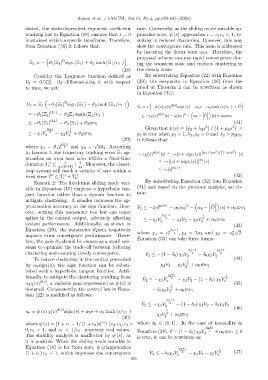
              Ξ 2 = − ϑ 1 |Ξ 1 | sign (Ξ 1 ) + ϑ 2 tanh (Ξ 1 /υ 1 )  ing the transient state and reduces chattering in
                                                       (28)   the steady state.
                Consider the Lyapunov function defined as         By substituting Equation (22) with Equation
                       2
            V 3 = 0.5Ξ . By differentiating it with respect   (30), the inequality in Equation (26) from the
                       1
            to time, we get:                                  proof of Theorem 2 can be rewritten as shown
                                                              in Equation (31):

                              Ω
             V 3 = Ξ 1 −ϑ 1 |Ξ 1 | sign (Ξ 1 ) − ϑ 2 tanh (Ξ 1 /υ 1 )       ϕ(s)
                                                              ˙
                                                                                                           ˜
                                                              V 2 = s −ψ (s) χ(s)  sign (s) − α 5 s − α 6 tanh (s/υ 1 ) + D
              = −ϑ 1 |Ξ 1 | Ω+1  − ϑ 2 Ξ 1 tanh (Ξ 1 /υ 1 )     ≤ −ιχ(s) ϕ(s)  |s| − α 5 |s 1 | − α 6 − D |s| + α 6 ϖυ 1


                                                                                            ˜
                                                                                   2

              ≤ −ϑ 1 |Ξ 1 | Ω+1  − ϑ 2 |Ξ 1 | + ϑ 2 ϖυ 1                                                 (31)
                                                                  Given that ϕ (s) = p 2 + λ 2 s 2   / 1 + µ 2 s 2   ≥
                      Ω+1       1
              ≤ −χ 1 V  2  − χ 2 V  2  + ϑ 2 ϖυ 1
                     3         3                              p 2 is true when p 2 > 1, λ 2 , µ 2 > 0 and λ 2 > p 2 µ 2 ,
                                                       (29)   it follows that:
                                           √
                            Ω+1
            where χ 1 = ϑ 1 2  2  and χ 2 =  2ϑ 2 . According
                                                                                                 2
                                                                                                        2
            to Lemma 1, the trajectory tracking error Ξ 1 ap-  − ιχ(s) ϕ(s)  |s| = −ι|s + sign (s)| (p 2 +λ 2 s )/(1+µ 2 s )  |s|
            proaches an area near zero within a fixed-time             ≤ −ι(|s| + |sign (s)|) |s|
                                                                                          p 2
                       ′
            duration T s ≤    2   +  2  . Moreover, the closed-
                           χ 1 (Ω+1)  χ 2                                     p 2 +1
            loop system will reach a vicinity of zero within a         ≤ −ι|s|
                              ′
                                   ′
                        ′
            fixed time T ≤ T r + T s .                                                                   (32)
                Remark 2: The fixed-time sliding mode vari-       By substituting Equation (32) into Equation
            able in Equation (16) employs a hyperbolic tan-   (31) and based on the previous analysis, we ob-
                                                              tain:
            gent function rather than a signum function to
            mitigate chattering. A smaller increases the ap-

                                                                                               ˜
                                                               ˙
                                                                                    2
            proximation accuracy to the sign function. How-   V 2 ≤ −ι|s| p 2 +1  − α 5 |s 1 | − α 6 − D |s| + α 6 ϖυ 1

            ever, setting this parameter too low can cause
                                                                         p 2 +1            1
            spikes in the control output, adversely affecting    ≤ −χ 3 V 2  2  − χ 4 V 2 − χ 5 V 2 2  + α 6 ϖυ 1
            system performance. Additionally, as shown in                                                (33)
            Equation (29), the parameter ϑ 2 ϖυ 1 negatively                 p 2 +1                     ∗ √
            impacts error convergence performance. There-     where χ 3 = ι2  2 , χ 4 = 2α 5 and χ 5 = α 6  2.
            fore, the gain ϑ 2 should be chosen as a small con-  Equation (33) can take three forms:
            stant to optimize the trade-off between reducing
                                                                                     p 2 +1      p 2 +1
                                                                  ˙
            chattering and ensuring timely convergence.           V 2 ≤ − (1 − δ 0 ) χ 3 V 2  2  − δ 0 χ 3 V 2  2
                To reduce chattering in the control generated                       1                    (34)
            by α 6 sign (s), the sign function can be substi-         − χ 4 V 2 − χ 5 V 2 2  + α 6 ϖυ 1
            tuted with a hyperbolic tangent function. Addi-
                                                                            p 2 +1                   1
            tionally, to mitigate the chattering resulting from  V 2 ≤ −χ 3 V  2  − χ 4 V 2 − (1 − δ 0 ) χ 5 V  2
                                                                 ˙
            α 4 χ(s) ϕ(s) , a variable gain represented as ψ (s) is        2                         2   (35)
                                                                             1
            designed. Consequently, the control law in Equa-         − δ 0 χ 5 V  2  + α 6 ϖυ 1
                                                                            2
            tion (22) is modified as follows:
                                                                           p 2 +1
                                                                ˙
                                                                V 2 ≤ −χ 3 V 2  2  − (1 − δ 0 ) χ 4 V 2 − δ 0 χ 4 V 2
            u b = ψ (s) χ(s) ϕ(s) sign (s) + α 5 s + α 6 tanh (s/υ 1 )     1                             (36)
                                                                    − χ 5 V 2 2  + α 6 ϖυ 1
                                                       (30)
                                              c 3
            where ψ (s) = [1 + c 1 − 1/ (1 + c 2 |s| ) ] c 4 . c 2 , c 3 >  where δ 0 ∈ (0, 1). In the case of inequality in
                                                                                            p 2 +1
            0, c 4 > 1, and c 1 < 1/c 4 represent real values.                                2
                                                              Equation (34), if − (1 − δ 0 ) χ 3 V 2  +α 6 ϖυ 1 ≤ 0
            The stability analysis is unaffected by ψ (s), as
                                                              is true, it can be rewritten as:
            it is positive. When the sliding mode variable in
            Equation (16) is far from zero, ψ (s)approaches                     p 2 +1            1
                                                                    ˙
            (1 + c 1 ) c 4 > 1, which improves the convergence     V 2 ≤ −δ 0 χ 3 V 2  2  − χ 4 V 2 − χ 5 V 2 2  (37)
                                                           676

