


Page 149 - IJOCTA-15-4
P. 149
Green innovation efficiency measurement and its influencing factors in specialized and new enterprises
organizations, regardless of the influence of the Charnes–Cooper–Rhodes (CCR) model with
dimension. DEA will measure the efficiency of fixed constant returns to scale in the DEA
the decision-making unit. The principle of effi- method. By applying SNEs as decision-making
ciency measurement is to project the decision- units, the potential boundary of GIE of these
making unit, using multiple inputs and outputs, businesses was created. It was assumed that
onto the DEA production frontier. The produc- there were n decision-making units in the produc-
tion frontier is a generalization of the production tion system, and each decision-making unit used
function to the multi-output situation. It is an m kinds of inputs, produced s kinds of expected
m
optimal solution set composed of the Pareto opti- outputs, which were denoted as x ∈ R , and
s
mal solutions to achieve the minimum input and y ∈ R , and were defined as matrices X and Y, as
maximum output. Combined with the linear pro- shown in Equations (1) and (2).
gramming approach, it is mainly used to measure
the efficiency of decision-making units with com- X = (x 1 , x 2 , Λ, x n ) ∈ R m×n (1)
plex production relationships and reduce the role
of subjective influence by comparing the size of Y = (y 1 , y 2 , Λ, y n ) ∈ R s×n (2)
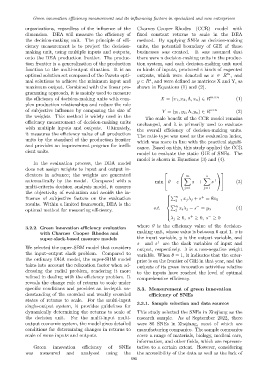
the weights. This method is widely used in the The scale benefit of the CCR model remains
efficiency measurement of decision-making units unchanged, and it is primarily used to evaluate
with multiple inputs and outputs. Ultimately, the overall efficiency of decision-making units.
it measures the efficiency value of all production The ratio type was used as the evaluation index,
units by the standard of the production frontier which was more in line with the practical signifi-
and provides an improvement program for ineffi-
cance. Based on this, this study applied the CCR
cient units.
model to evaluate the static GIE of SNEs. The
model is shown in Equations (3) and (4).
In the evaluation process, the DEA model
does not assign weights to input and output in-
dicators in advance; the weights are generated m s
X X
−
automatically by the model. Compared with a min θ − ε s + s + (3)
multi-criteria decision analysis model, it ensures j=1 j=1
the objectivity of evaluation and avoids the in-
P n +
fluence of subjective factors on the evaluation x j λ j + s = θx 0
j=1
results. Within a limited framework, DEA is the P n −
optimal method for measuring efficiency. s.t. j x i λ j − s = y 0 (4)
λ j ≥ 0, s ≥ 0, s ≥ 0
+ −
where θ is the efficiency value of the decision-
3.2.2. Green innovation efficiency evaluation
with Charnes–Cooper–Rhodes and making unit, whose value is between 0 and 1. x is
super-slack-based measure models the input variable, y is the output variable, and
s − and s + are the slack variables of input and
We selected the super-SBM model that considers output, respectively. λ is a non-negative weight
the input–output slack problem. Compared to variable. When θ = 1, it indicates that the enter-
the ordinary DEA model, the super-SBM model prise is on the frontier of GIE in that year, and the
takes into account the relaxation factor when ad- outputs of its green innovation activities relative
dressing the radial problem, rendering it more
to the inputs have reached the level of optimal
refined in dealing with the efficiency problem. It
comprehensive efficiency.
reveals the change rule of returns to scale under
specific conditions and provides an in-depth un- 3.3. Measurement of green innovation
derstanding of the crowded and weakly crowded efficiency of SNEs
states of returns to scale. For the multi-input
3.3.1. Sample selection and data sources
single-output system, it provides guidelines for
dynamically determining the returns to scale of This study selected the SNEs in Zhejiang as the
the decision unit. For the multi-input multi- research sample. As of September 2022, there
output economic system, the model gives detailed were 86 SNEs in Zhejiang, most of which are
conditions for determining changes in returns to manufacturing companies. The sample companies
scale of some inputs and outputs. cover a range of materials, biology, medical care,
information, and other fields, which are represen-
Green innovation efficiency of SNEs tative to a certain extent. However, considering
was measured and analyzed using the the accessibility of the data as well as the lack of
691

