


Page 70 - IJPS-1-1
P. 70
Undocumented migration in response to climate change

                                      to account for the  correlation  between  climate and  elevation using  a Digital Elevation
                                      Model (DEM) (Danielson and Gesch, 2011) as a covariate in the interpolation model. We
                                      employed a bootstrap resampling procedure to cross-validate the interpolation results and
                                      found the local estimates to be robust. Using a lattice of 700 × 700 m, we then extracted
                                      climate change values from the interpolation surface and assigned the respective area av-
                                      erage to each MMP municipality for which migration histories were available.
                                        Finally, we computed relative change measures as the standardized difference between
                                      the climate index value during the 3-year window leading up to each observational year
                                      and a 30-year (1961–1990) long-term average. A 3-year window was chosen to minimize
                                      the influence of short-term fluctuations and to account for lagged response patterns
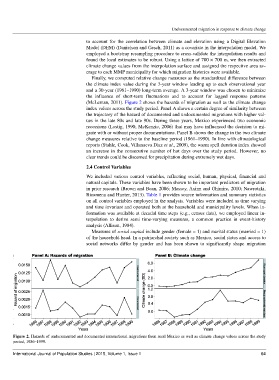
                                      (McLeman, 2011). Figure 2 shows the hazards of migration as well as the climate change
                                      index values across the study period. Panel A shows a certain degree of similarity between
                                      the trajectory of the hazard of documented and undocumented migrations with higher val-
                                      ues in the late 80s and late 90s. During these years, Mexico experienced two economic
                                      recessions (Lustig, 1990; McKenzie, 2006) that may have influenced the decision to mi-
                                      grate with or without proper documentations. Panel B shows the change in the two climate
                                      change measures relative to the baseline period (1961–1990). In line with climatological
                                      reports (Stahle, Cook, Villanueva Diaz et al., 2009), the warm spell duration index showed
                                      an increase in the  consecutive number of hot days over the study period. However, no
                                      clear trends could be discerned for precipitation during extremely wet days.

                                      2.4 Control Variables
                                      We included various control variables, reflecting  social, human, physical, financial and
                                      natural capitals. These variables have been shown to be important predictors of migration
                                      in prior research (Brown and Bean, 2006; Massey, Axinn and Ghimire, 2010; Nawrotzki,
                                      Riosmena and Hunter, 2013). Table 1 provides source information and summary statistics
                                      on all control variables employed in the analysis. Variables were included as time varying
                                      and time invariant and operated both at the household and municipality levels. When in-
                                      formation was available at decadal time steps (e.g., census data), we employed linear in-
                                      terpolation to derive semi time-varying  measures, a common  practice in  event-history
                                      analysis (Allison, 1984).
                                        Measures of social capital include gender (female = 1) and marital status (married = 1)
                                      of the household head. In a patriarchal society such as Mexico, social status and access to
                                      social networks differ by gender and has been shown to significantly shape  migration


       Figure 2. Hazards of undocumented and documented international migrations from rural Mexico as well as climate change values across the study
       period, 1986–1999.

       International Journal of Population Studies | 2015, Volume 1, Issue 1                                    64

