


Page 71 - IJPS-1-1
P. 71
Raphael J. Nawrotzki, Fernando Riosmena, Lori M. Hunter, and Daniel M. Runfola

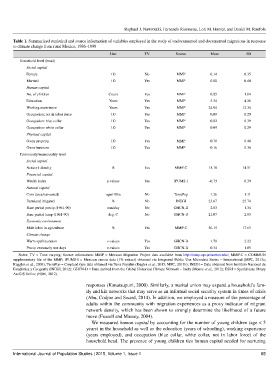
       Table 1. Summarized statistical and source information of variables employed in the study of undocumented and documented migrations in response
       to climate change from rural Mexico, 1986–1999
                                                Unit           TV           Source         Mean           SD
          Household level (head)
            Social capital
            Female                              1|0            No           MMP            0.14          0.35
            Married                             1|0            Yes          MMP            0.80          0.40
            Human capital
            No. of children                    Count           Yes          MMP            0.85          1.04
            Education                           Years          Yes          MMP            5.34          4.28
            Working experience                  Years          Yes          MMP           24.94         12.34
            Occupation: not in labor force      1|0            Yes          MMP            0.09          0.29
            Occupation: blue collar             1|0            Yes          MMP            0.82          0.39
            Occupation: white collar            1|0            Yes          MMP            0.09          0.29
            Physical capital
            Owns property                       1|0            Yes          MMP            0.70          0.46
            Owns business                       1|0            Yes          MMP            0.16          0.36
          Community/municipality level
            Social capital
            Network density                      %             Yes          MMP-C         15.18         14.51
            Financial capital
            Wealth index                       z-values        Yes         IPUMS-I        –0.79          0.39
            Natural capital
            Corn (area harvested)             sqm/10ha         No          TerraPop        1.26          1.11
            Farmland irrigated                   %             No           INEGI         23.67         25.74
            Base period precip (1961-90)       mm/day          No          GHCN-D          2.83          1.34
            Base period temp (1961-90)         deg. C          No          GHCN-D         21.07          2.93
            Economic environment
            Male labor in agriculture            %             Yes          MMP-C         56.15         17.65
            Climate change
            Warm spell duration                z-values        Yes         GHCN-D          1.79          2.22
            Precip extremely wet days          z-values        Yes         GHCN-D          0.34          1.05
         Notes: TV = Time varying; Source information: MMP = Mexican Migration Project data available  from  http://mmp.opr.princeton.edu/; MMP-C = COMMUN
       supplementary file of the MMP; IPUMS-I = Mexican census data (1% extract) obtained via Integrated Public Use Microdata Series – International (MPC, 2013a;
       Ruggles et al., 2003); TerraPop = Cropland type data obtained via Terra Populus (Kugler et al., 2015; MPC, 2013b); INEGI = Data obtained from Instituto Nacional de
       Estadística y Geografía (INEGI, 2012); GHCN-D = Data derived from the Global Historical Climate Network – Daily (Menne et al., 2012); ESRI = Spatial data library
       ArcGIS Online (ESRI, 2012).

                                      responses (Kanaiaupuni, 2000). Similarly, a marital union may expand a household’s fam-
                                      ily and kin networks that may serve as an informal social security system in times of crisis
                                      (Abu, Codjoe and Sward, 2014). In addition, we employed a measure of the percentage of
                                      adults within the community with migration experiences as a proxy indicator of migrant
                                      network density, which has been shown to strongly determine the likelihood of a future
                                      move (Fussell and Massey, 2004).
                                        We measured human capital by accounting for the number of young children (age < 5
                                      years) in the household as well as the education (years of schooling), working experience
                                      (years employed), and occupation (blue collar, white collar, not in labor force) of the
                                      household head. The presence of young children ties human capital needed for nurturing

       International Journal of Population Studies | 2015, Volume 1, Issue 1                                    65

