


Page 72 - IJPS-1-1
P. 72
Undocumented migration in response to climate change
activities to the household and has been shown to reduce the odds of an international move
(Massey & Riosmena, 2010; Nawrotzki, Riosmena and Hunter, 2013). We were unable to
include a measure for age of the household head in the models due to high correlation with
working experience (r = 0.93) and resulting multi-collinearity.
Financial capital is measured by a standardized wealth index at the municipality level
that combines information from 10 variables on the quality of housing (floor material, wall,
roof, number of rooms, toilet type) as well as service and infrastructure access (water
supply, electricity, sewage system, cooking fuel type) (Cronbach’s alpha = 0.85). In the
developing world, migration is often used as a means to overcome liquidity constraints to
purchase a home or start a business (Massey and Parrado, 1998; Taylor, Arango, Hugo et
al., 1996). To account for this relationship, we measured the level of physical capital in
terms of business or property ownership (owner = 1) at the household level.
As a measure of natural capital we accounted for the general agricultural dependence
by using a measure of the corn area harvested. This measure was constructed by the Glob-
al Landscape Initiative (Monfreda, Ramakutty and Foley, 2008) for the year 2000 and is
available through the Terra Populus data extract system (Kugler, Van Riper, Manson et al.,
2015; MPC, 2013b). Since the impact of climate effects on livelihoods may depend on the
ability to employ technological infrastructure (Gutmann and Field, 2010), we accounted
for access to irrigation systems through a measure of the percentage of farmland irrigated.
This data was obtained from the Mexican agricultural census (INEGI, 2012) and averaged
across the years 2003–2005. In addition, prior research has shown that the effects of cli-
mate variability on migration differ based on the general climatic context (Nawrotzki,
Riosmena and Hunter, 2013). To account for the general climatic background, we included
measures of the average temperature and precipitation during the baseline years
(1961–1990). Finally, we captured employment in climate sensitive sectors through a
measure of the percentage of males in the labor force employed in agriculture.
2.5 Estimation Strategy
We employed event-history models for this analysis (Allison, 1984). The models were es-
timated within a competing risk framework, in which the household can either perform an
undocumented or documented move (Singer and Willett, 2003). Owing to the hierarchical
structure of our data, we employed a multi-level version of the event-history model that
accounted for the nesting of households within municipalities (Steele Diamond and Amin,
1996; Steele, Goldstein and Browne, 2004). To guard against endogeneity, all predictors
were lagged by one year (Gray, 2009; Gray, 2010).
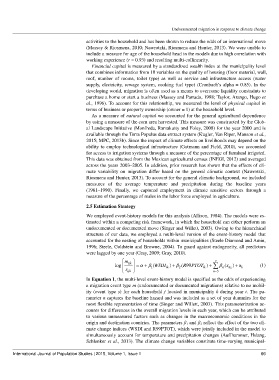
m y
R
log ijk α = β + (WSDI ) β + ( 99PTOT ) + ∑ β (x ) u (1)
+
s 1 ik 2 ik n nz k
ijk n= 3
In Equation 1, the multi-level event-history model is specified as the odds of experiencing
a migration event type m (undocumented or documented migrations) relative to no mobil-
ity (event type s) for each household j located in municipality k during year i. The pa-
rameter α captures the baseline hazard and was included as a set of year dummies for the
most flexible representation of time (Singer and Willett, 2003). This parameterization ac-
counts for differences in the overall migration levels in each year, which can be attributed
to various unmeasured factors such as changes in the macroeconomic conditions in the
origin and destination countries. The parameters β 1 and β 2 reflect the effect of the two cli-
mate change indices (WSDI and R99PTOT), which were jointly included in the model to
simultaneously account for temperature and precipitation changes (Auffhammer, Hsiang,
Schlenker et al., 2013). The climate change variables constitute time-varying municipal-
International Journal of Population Studies | 2015, Volume 1, Issue 1 66

