


Page 74 - IJPS-1-1
P. 74
Undocumented migration in response to climate change

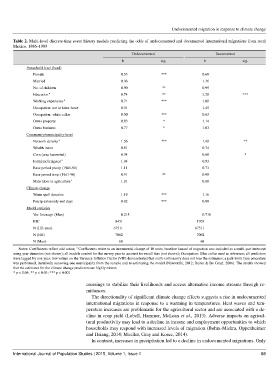
       Table 2. Multi-level discrete-time event history models predicting the odds of undocumented and documented international migrations from rural
       Mexico, 1986–1999
                                                         Undocumented                        Documented
                                                     b                sig.              b                sig.
            Household level (head)
               Female                                0.53             ***              0.68
               Married                               0.96                              1.36
               No. of children                       0.90             **               0.99
               Education                             0.74             **               3.29              ***
                       a
               Working experience                    0.71             ***              1.00
                             a
               Occupation: not in labor force        0.91                              1.45
               Occupation: white collar              0.50             ***              0.63
               Owns property                         0.83              *               1.14
               Owns business                         0.77              *               1.03
            Community/municipality level
                           a
               Network density                       1.56             ***              1.49              **
               Wealth index                          0.81                              0.74
               Corn (area harvested)                 0.94                              0.68              *
                            a
               Farmland irrigated                    1.04                              0.93
               Base period precip (1961-90)          1.11                              0.73
               Base period temp (1961-90)            0.91             **               0.98
                                a
               Male labor in agriculture             1.01                              0.88
            Climate change
               Warm spell duration                   1.19             ***              1.16
               Precip extremely wet days             0.82             ***              0.98
            Model statistics
               Var. Intercept (Mun)                  0.215                             0.718
               BIC                                8451                               1703
               N (HH-year)                        67511                             67511
               N (HH)                             7062                               7062
               N (Mun)                              68                                 68
                                  a
         Notes: Coefficients reflect odd ratios;   Coefficients relate to an incremental change of 10 units; baseline hazard of migration was included as a multi-part intercept
       using year dummies (not shown); all models control for the survey year to account for recall bias (not shown); Occupation: Blue collar used as reference; all predictors
       were lagged by one year; low values on the Variance Inflation Factor (VIF) demonstrated that multi-collinearity does not bias the estimates; a jack-knife type procedure
       was performed, iteratively removing one municipality from the sample and re-estimating the model (Nawrotzki, 2012; Ruiter & De Graaf, 2006). The results showed
       that the estimates for the climate change predictors are highly robust;
       * p < 0.05; ** p < 0.01; *** p < 0.001

                                      crossings to stabilize their livelihoods and access alternative income streams through re-
                                      mittances.
                                        The directionality of significant climate change effects suggests a rise in undocumented
                                      international migrations in response to a warming in temperatures. Heat waves and tem-
                                      perature increases are problematic for the agricultural sector and are associated with a de-
                                      cline in crop yield (Lobell, Hammer, McLean et al., 2013). Adverse impacts on agricul-
                                      tural productivity may lead to a decline in income and employment opportunities to which
                                      households may respond with increased levels of migration (Bohra-Mishra, Oppenheimer
                                      and Hsiang, 2014; Mueller, Gray and Kosec, 2014).
                                        In contrast, increases in precipitation led to a decline in undocumented migrations. Only

       International Journal of Population Studies | 2015, Volume 1, Issue 1                                    68

