


Page 84 - IJPS-1-1
P. 84
A simulation analysis of the longer-term effects of immigration on per capita income in an aging population

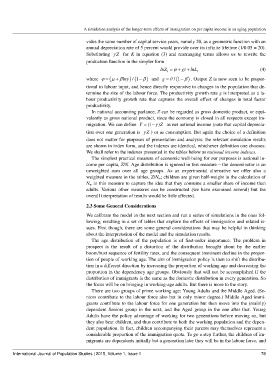
                                      vides the same number of capital service years, namely 20, as a geometric function with an
                                      annual depreciation rate of 5 percent would provide over its infinite lifetime (1/0.05 = 20).
                                      Substituting  γ Z   for  K  in equation (3)  and  rearranging terms  allows us to rewrite the
                                      production function in the simpler form
                                                                     lnZ =  t  ϕ +  gt lnL+  t                  (4)
                                                                )
                                                     ln
                                                  +
                                                            −
                                      where  ϕ =  (µ βγ ) ( /1 β   and  g θ  =  ( /1 β  −  ) . Output Z is now seen to be propor-
                                      tional to labour input, and hence directly responsive to changes in the population that de-
                                      termine the size of the labour force. The productivity growth rate g is interpreted as a la-
                                      bour productivity growth rate that captures the overall  effect of changes in  total factor
                                      productivity.
                                        In national accounting parlance, Z can be regarded as gross domestic product, or equi-
                                      valently as gross national product, since the economy is closed in all respects except im-
                                      migration. We can define  Y = (1 γ−  )Z   as net national income (note that capital deprecia-
                                      tion over one generation is  Zγ  ) or as consumption. But again the choice of a definition
                                      does not matter for purposes of presentation and analysis: the relevant simulation results
                                      are shown in index form, and the indexes are identical, whichever definition one chooses.
                                      We shall refer to the indexes presented in the tables below as national income indexes.
                                        The simplest practical measure of economic well-being for our purposes is national in-
                                      come per capita, Z/N. Age distribution is ignored in this measure – the denominator is an
                                      unweighted  sum  over  all  age  groups.  As  an  experimental alternative  we  offer also  a
                                      weighted measure in the tables, Z/N w; children are given half-weight in the calculation of
                                      N w in this measure to capture the idea that they consume a smaller share of income than
                                      adults. Various other measures can be constructed (we have examined several) but the
                                      overall interpretation of results would be little affected.

                                      2.3 Some General Considerations
                                      We calibrate the model in the next section and run a series of simulations in the ones fol-
                                      lowing, resulting in a set of tables that explore the effects of immigration and related is-
                                      sues. First though, there are some general considerations that may be helpful in thinking
                                      about the interpretation of the model and the simulation results.
                                        The age distribution of the population is of  first-order importance. The problem in
                                      prospect  is  the  result  of  a  distortion  of  the  distribution  brought  about  by  the  earlier
                                      boom/bust sequence of fertility rates, and the consequent imminent decline in the propor-
                                      tion of people of working age. The aim of immigration policy is then to shift the distribu-
                                      tion in a different direction by increasing the proportion of working age and decreasing the
                                      proportion in the dependency age groups. Obviously that will not be accomplished if the
                                      distribution of immigrants is the same as the domestic distribution in every generation. So
                                      the focus will be on bringing in working-age adults. But there is more to the story.
                                        There are two groups of prime working age: Young Adults and the Middle Aged. (Se-
                                      niors contribute to the labour force also but in only minor degree.) Middle Aged immi-
                                      grants contribute to the labour force for one generation but then move into the (mainly)
                                      dependent Seniors group in the next, and the Aged group in the one after that. Young
                                      Adults have the policy advantage of working for two generations before moving on, but
                                      they also bear children, and thus contribute to both the working population and the depen-
                                      dent population. In fact, children accompanying their parents may themselves represent a
                                      considerable proportion of the immigration quota. To go a step further, the children of im-
                                      migrants are dependents initially but a generation later they will be in the labour force, and

       International Journal of Population Studies | 2015, Volume 1, Issue 1                                    78

