


Page 86 - IJPS-1-1
P. 86
A simulation analysis of the longer-term effects of immigration on per capita income in an aging population

                                      distributed as 25 percent Children, 50 percent Young Adults, and 25 percent Middle Aged.

                                      3. Results

                                      3.1 Initial Simulations
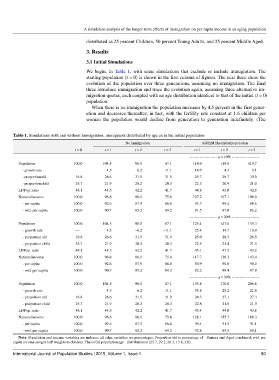
                                      We begin, in  Table 1, with some simulations that exclude or include immigration. The
                                      starting population (t = 0) is shown in the first column of figures. The next three show the
                                      evolution of the population over three generations, assuming no immigration. The final
                                      three introduce immigration and trace the evolution again, assuming three alternative im-
                                      migration quotas, each coupled with an age distribution identical to that of the initial (t = 0)
                                      population.
                                        When there is no immigration the population increases by 4.5 percent in the first gener-
                                      ation and decreases thereafter; in fact, with the fertility rate constant at 1.6 children per
                                      woman the population would decline from generation to generation indefinitely. (The


       Table 1. Simulations with and without immigration; immigrants distributed by age as in the initial population
                                                       No immigration                  AGEIM like initial population
                                 t = 0        t = 1        t = 2       t = 3        t = 1      t = 2       t = 3
                                                                                  --------------------- q = 10% ---------------------
         Population             100.0        104.5         98.0        87.1        114.9       119.8       119.7
           - growth rate         —             4.5         –6.2        –11.1        14.9         4.3        –0.1
           - proportion old      16.8         26.6         31.5        31.9         25.7        29.7        30.0
           - proportion child    25.7         21.9         20.2        20.3         22.3        20.9        21.0
         LF/Pop. ratio           48.1         44.5         42.2        41.7         44.8        43.0        42.6
         National income        100.0         96.8         86.1        75.6        107.2       107.1       106.0
           - per capita         100.0         92.6         87.9        86.8         93.3        89.4        88.6
           - wtd. per capita    100.0         90.7         85.2        84.2         91.5        87.0        86.2
                                                                                  --------------------- q = 20% ---------------------
         Population             100.0        104.5         98.0        87.1        125.4       143.8       159.3
           - growth rate         —             4.5         –6.2        –11.1        25.4        14.7        10.8
           - proportion old      16.8         26.6         31.5        31.9         25.0        28.3        28.5
           - proportion child    25.7         21.9         20.2        20.3         22.5        21.4        21.5
         LF/Pop. ratio           48.1         44.5         42.2        41.7         45.1        43.5        43.2
         National income        100.0         96.8         86.1        75.6        117.7       130.3       143.4
           - per capita         100.0         92.6         87.9        86.8         93.9        90.6        90.0
           - wtd. per capita    100.0         90.7         85.2        84.2         92.2        88.4        87.9
                                                                                  --------------------- q = 30% ---------------------
         Population             100.0        104.5         98.0        87.1        135.8       170.0       206.8
           - growth rate         —             4.5         –6.2        –11.1        35.8        25.2        21.6
           - proportion old      16.8         26.6         31.5        31.9         24.3        27.1        27.3
           - proportion child    25.7         21.9         20.2        20.3         22.8        21.8        21.9
         LF/Pop. ratio           48.1         44.5         42.2        41.7         45.4        44.0        43.8
         National income        100.0         96.8         86.1        75.6        128.1       155.7       188.3
           - per capita         100.0         92.6         87.9        86.8         94.4        91.5        91.1
           - wtd. per capita    100.0         90.7         85.2        84.2         92.8        89.5        89.1
         Note: Population and income variables are indexes; all other variables are percentages. Proportion old is percentage of  Seniors and Aged combined; wtd. per
       capita income assigns half weights to children. The initial population age  distribution is (25.7, 29.2, 28.3, 13.8, 3.0).

       International Journal of Population Studies | 2015, Volume 1, Issue 1                                    80

