


Page 90 - IJPS-1-1
P. 90
A simulation analysis of the longer-term effects of immigration on per capita income in an aging population

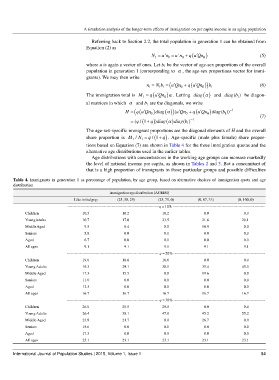
                                        Referring back to Section 2.2, the total population in generation 1 can be obtained from
                                      Equation (2) as
                                                                                         )
                                                                                     ′
                                                                  N =  ' un =  ' un +  ( q u Qn                 (5)
                                                                               0
                                                                   1
                                                                         1
                                                                                        0
                                      where u is again a vector of ones. Let b 1 be the vector of age-sex proportions of the overall
                                      population in generation 1 (corresponding to  α , the age-sex proportions vector for immi-
                                      grants). We may then write
                                                                           ′
                                                                                    ′
                                                                n =  N b = (u Qn +  ( q u Qn 0  )) 1            (6)
                                                                                          b
                                                                1
                                                                     11
                                                                              0
                                                                                        ( )
                                                                    ′
                                      The immigration total is  M =  ( q u Qn 0 )α . Letting  diag α   and  diag ()b   be diagon-
                                                                                                      1
                                                              1
                                      al matrices in which  α   and b 1 are the diagonals, we write
                                                                  )
                                                                                          )
                                                                                      ′
                                                      H =   ( (q u Qn diag ( )) (u Qnα  ′  0  +  ( q u Qn diag ( ))b 1  − 1
                                                              ′
                                                                                         0
                                                                 0
                                                                                                                (7)
                                                         = (q  ( /1 q ))diag ( )diagα  ( )b 1  − 1
                                                                +
                                      The age-sex-specific immigrant proportions are the diagonal elements of H and the overall
                                      share proportion is  M 1  / N =  q  ( /1 q+  ) . Age-specific (male  plus female) share propor-
                                                             1
                                      tions based on Equation (7) are shown in Table 4 for the three immigration quotas and the
                                      alternative age distributions used in the earlier tables.
                                        Age distributions with concentrations in the working age groups can increase markedly
                                      the level of national income per capita, as shown in Tables 2 and 3. But a concomitant of
                                      that is a high proportion of immigrants in those particular groups and possible difficulties

       Table 4. Immigrants in generation 1 as percentage of population, by age group, based on alternative choices of  immigration quota and age
       distribution
                                                Immigration age distribution (AGEIM)
                                 Like initial pop.   (25, 50, 25)   (25, 75, 0)      (0, 67, 33)      (0, 100, 0)
                              ----------------------------------------------------------------------q = 10% ----------------------------------------------------------------------
            Children                10.5             10.2             10.2              0.0              0.0
            Young Adults            10.7             17.0             23.5             21.6             29.1
            Middle Aged              9.5              8.4              0.0             10.9              0.0
            Seniors                  5.8              0.0              0.0              0.0              0.0
            Aged                     6.7              0.0              0.0              0.0              0.0
            All ages                 9.1              9.1              9.1              9.1              9.1
                              ---------------------------------------------------------------------- q = 20% ----------------------------------------------------------------------
            Children                19.0             18.6             18.6              0.0              0.0
            Young Adults            19.3             29.1             38.1             35.4             45.0
            Middle Aged             17.3             15.5              0.0             19.6              0.0
            Seniors                 11.0              0.0              0.0              0.0              0.0
            Aged                    12.5              0.0              0.0              0.0              0.0
            All ages                16.7             16.7             16.7             16.7             16.7
                              ---------------------------------------------------------------------- q = 30% ----------------------------------------------------------------------
            Children                26.0             25.5             25.5              0.0              0.0
            Young Adults            26.4             38.1             47.9             45.2             55.2
            Middle Aged             23.8             21.7              0.0             26.7              0.0
            Seniors                 15.6              0.0              0.0              0.0              0.0
            Aged                    17.3              0.0              0.0              0.0              0.0
            All ages                23.1             23.1             23.1             23.1             23.1

       International Journal of Population Studies | 2015, Volume 1, Issue 1                                    84

