


Page 91 - IJPS-1-1
P. 91
Frank T. Denton and Byron G. Spencer

                                      of absorbing the implied large numbers of newcomers of a given age into the society. The
                                      issue of absorption lies outside our model framework but it is something that the govern-
                                      ment would have to consider. The extreme situations in both national income benefits and
                                      possible absorption difficulties occur when only Young Adult immigrants are admitted to
                                      the country — the distribution (0, 100, 0). With a quota of 10 percent, 29 percent of the
                                      population in that age group are immigrants; with a 20 percent quota, 45 percent are im-
                                      migrants; and with a 30 percent quota the proportion is well over half, 55 percent. Even
                                      with the somewhat less concentrated (0, 67, 33) distribution the proportion in the Young
                                      Adult age group reaches 35 percent with a 20 percent quota and 45 percent with a quota of
                                      30 percent. The policy choice that the government must make poses a tradeoff — accept-
                                      ing a lower level of income per capita than what might be attainable through immigration
                                      vs. possible societal absorption difficulties with a higher immigration quota.

                                      3.5 Productivity Growth as an Offset to Population Aging
                                      The rate of growth of productivity is denoted by g in Equation (4), Section 2.2. We have
                                      set g to zero in all of the simulations thus far. Now we experiment with positive values.
                                      The immigration quota and  age distribution are under government control; the  rate of
                                      productivity growth is not. The government may be able to nudge the rate a little by this or
                                      that policy but the extent of its influence is no doubt limited. Nevertheless, it is of interest
                                      to see how productivity growth might act as an offset to the negative effect of population
                                      aging on the economy.
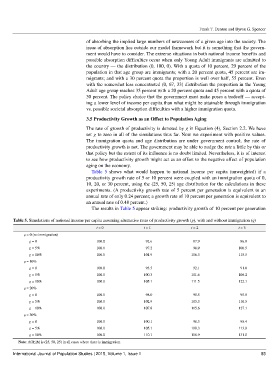
                                        Table 5  shows what would happen to national income per capita (unweighted) if a
                                      productivity growth rate of 5 or 10 percent were coupled with an immigration quota of 0,
                                      10, 20, or 30 percent, using the (25, 50, 25) age distribution for the calculations in these
                                      experiments. (A productivity growth rate of 5 percent per generation is equivalent to an
                                      annual rate of only 0.24 percent; a growth rate of 10 percent per generation is equivalent to
                                      an annual rate of 0.48 percent.)
                                        The results in Table 5 appear striking: productivity growth of 10 percent per generation

       Table 5. Simulations of national income per capita assuming alternative rates of productivity growth (g), with and without immigration (q)
                                          t = 0               t = 1                t = 2               t = 3
           q = 0 (no immigration)
             g = 0                        100.0                92.6                87.9                 86.8
             g = 5%                       100.0                97.2                96.9                100.5
             g = 10%                      100.0               101.9                106.3               115.5
           q = 10%
             g = 0                        100.0                95.5                92.1                 91.8
             g = 5%                       100.0               100.3                101.6               106.2
             g = 10%                      100.0               105.1                111.5               122.1
           q = 20%
             g = 0                        100.0                98.0                95.5                 95.5
             g = 5%                       100.0               102.9                105.3               110.5
             g = 10%                      100.0               107.8                115.6               127.1
           q = 30%
             g = 0                        100.0               100.1                98.3                 98.4
             g = 5%                       100.0               105.1                108.3               113.9
             g = 10%                      100.0               110.1                118.9               131.0
         Note: AGEIM is (25, 50, 25) in all cases where there is immigration.

       International Journal of Population Studies | 2015, Volume 1, Issue 1                                    85

