


Page 93 - IJPS-1-1
P. 93
Frank T. Denton and Byron G. Spencer

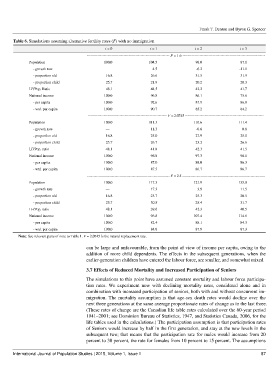
       Table 6. Simulations assuming alternative fertility rates (F) with no immigration
                                              t = 0              t = 1              t = 2              t = 3
                                      --------------------------------------------------------------- F = 1.6 ---------------------------------------------------------------
             Population                      100.0               104.5              98.0                87.1
               - growth rate                  —                   4.5                -6.2              -11.1
               - proportion old               16.8               26.6               31.5                31.9
               - proportion child             25.7               21.9               20.2                20.3
             LF/Pop. Ratio                    48.1               44.5               42.2                41.7
             National income                 100.0               96.8               86.1                75.6
               - per capita                  100.0               92.6               87.9                86.8
               - wtd. per capita             100.0               90.7               85.2                84.2
                                       ------------------------------------------------------------ F = 2.0745 ------------------------------------------------------------
             Population                      100.0               111.3              110.6              111.4
               - growth rate                  —                  11.3                -0.6               0.8
               - proportion old               16.8               25.0               27.9                25.0
               - proportion child             25.7               26.7               23.2                26.6
             LF/Pop. ratio                    48.1               41.8               42.3                41.5
             National income                 100.0               96.8               97.3                96.1
               - per capita                  100.0               87.0               88.0                86.3
               - wtd. per capita             100.0               87.5               86.7                86.7
                                      --------------------------------------------------------------- F = 2.5 ---------------------------------------------------------------
             Population                      100.0               117.3              121.9              135.9
               - growth rate                  —                  17.3                3.9                11.5
               - proportion old               16.8               23.7               25.3                20.5
               - proportion child             25.7               30.5               25.4                31.7
             LF/Pop. ratio                    48.1               39.6               42.3                40.5
             National income                 100.0               96.8               107.4              114.6
               - per capita                  100.0               82.4               88.1                84.3
               - wtd. per capita             100.0               84.8               87.9                87.3
         Note: See relevant parts of note to Table 1. F = 2.0745 is the natural replacement rate.

                                      can be large and unfavourable, from the point of view of income per capita, owing to the
                                      addition of more child dependents. The effects in the subsequent generations, when the
                                      earlier-generation children have entered the labour force, are smaller, and somewhat mixed.

                                      3.7 Effects of Reduced Mortality and Increased Participation of Seniors
                                      The simulations to this point have assumed constant mortality and labour force participa-
                                      tion rates.  We experiment now with declining  mortality  rates, considered alone and in
                                      combination with increased participation of seniors, both with and without concurrent im-
                                      migration. The  mortality assumption  is that age-sex  death  rates would  decline over the
                                      next three generations at the same average proportionate rates of change as in the last three.
                                      (These rates of change are the Canadian life table rates calculated over the 60-year period
                                      1941–2001; see Dominion Bureau of Statistics, 1947, and Statistics Canada, 2006, for the
                                      life tables used in the calculations.) The participation assumption is that participation rates
                                      of Seniors would increase by half in the first generation, and stay at the new levels in the
                                      subsequent two; that means that the participation rate for males would increase from 20
                                      percent to 30 percent, the rate for females from 10 percent to 15 percent. The assumptions

       International Journal of Population Studies | 2015, Volume 1, Issue 1                                    87

