


Page 95 - IJPS-1-1
P. 95
Frank T. Denton and Byron G. Spencer

                                      3.8 Effects of Differential Education Assumptions

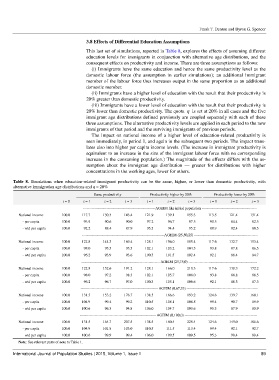
                                      This last set of simulations, reported in Table 8, explores the effects of assuming different
                                      education levels for immigrants in conjunction with alternative age distributions, and the
                                      consequent effects on productivity and income. There are three assumptions as follows:
                                        (i) Immigrants have the same education and hence the same productivity level as the
                                      domestic labour force (the assumption in earlier simulations); an additional immigrant
                                      member of the labour force thus increases output in the same proportion as an additional
                                      domestic member.
                                        (ii) Immigrants have a higher level of education with the result that their productivity is
                                      20% greater than domestic productivity.
                                        (iii) Immigrants have a lower level of education with the result that their productivity is
                                      20% lower than domestic productivity. The quota    is set at 20% in all cases and the five
                                      immigrant age distributions defined previously are coupled separately with each of these
                                      three assumptions. The alternative productivity levels are applied in each period to the new
                                      immigrants of that period and the surviving immigrants of previous periods.
                                        The impact on national income  of a higher level of education-related  productivity is
                                      seen immediately, in period 1, and again in the subsequent two periods. The impact trans-
                                      lates also into higher per capita income levels. (The increase in immigrant productivity is
                                      equivalent to an increase in the size of the immigrant labour force with no corresponding
                                      increase in the consuming population.) The magnitude of the effects differs with the as-
                                      sumption about the immigrant age distribution  —  greater for distributions with  higher
                                      concentrations in the working ages, lower for others.

       Table  8.  Simulations when  education-related immigrant productivity can be the same, higher, or lower than  domestic productivity, with
       alternative immigration age distributions and q = 20%

                                         Same productivity       Productivity higher by 20%   Productivity lower by 20%
                            t = 0    t = 1    t = 2   t = 3     t = 1    t = 2   t = 3     t = 1   t = 2    t = 3
                                            ----------------------------------------------------------AGEIM like initial population --------------------------------------------

         National income   100.0    117.7    130.3    143.4    121.9    139.1    155.3    113.5    121.4    131.4
           - per capita    100.0     93.9     90.6     90.0     97.2     96.7     97.5     90.5     84.4     82.5
           - wtd per capita   100.0   92.2    88.4     87.9     95.5     94.4     95.2     88.9     82.4     80.5
                                           ------------------------------------------------------------------AGEIM (25,50,25) ---------------------------------------------------

         National income   100.0    122.8    144.3    169.4    128.1    156.0    185.4    117.6    132.7    153.4
           - per capita    100.0     98.0     95.5     95.5    102.1    103.2    104.5     93.8     87.8     86.5
           - wtd per capita   100.0   96.2    93.9     93.6    100.3    101.5    102.4     92.1     86.4     84.7
                                           --------------------------------------------------------------- AGEIM (25,75,0) -------------------------------------------------------
         National income   100.0    122.8    152.6    191.2    128.1    166.0    210.3    117.6    139.3    172.2
           - per capita    100.0     98.0     97.2     98.3    102.1    105.7    108.0     93.8     88.8     88.5
           - wtd per capita   100.0   96.2    96.7     97.0    100.3    105.1    106.6     92.1     88.3     87.3
                                          -------------------------------------------------------------- AGEIM (0,67,33) ---------------------------------------------------------
         National income   100.0    131.5    153.2    176.7    138.5    166.6    193.2    124.6    139.7    160.1
           - per capita    100.0    104.9     99.4     99.2    110.5    108.1    108.5     99.4     90.7     89.9
           - wtd per capita   100.0   100.6   96.3     94.8    106.0    104.7    103.6     95.3     87.9     85.9
                                          ------------------------------------------------------------- AGEIM (0,100,0) ----------------------------------------------------------

         National income   100.0    131.5    164.7    207.5    138.5    180.4    228.4    124.6    149.0    186.6
           - per capita    100.0    104.9    101.8    103.0    110.5    111.5    113.4     99.4     92.1     92.7
           - wtd per capita   100.0   100.6   99.9     99.4    106.0    109.5    109.5     95.3     90.4     89.4
         Note: See relevant parts of note to Table 1.

       International Journal of Population Studies | 2015, Volume 1, Issue 1                                    89

