


Page 48 - IJPS-9-1
P. 48
International Journal of
            Population Studies                                                  Transportation assimilation in Hong Kong


            Table 3. (Continued)
                                                         Model 1                Model 2              Model 3
            Year FE                                        Yes                    Yes                 Yes
            Place of residence FE                          Yes                    Yes                 Yes
            Place of work FE                               Yes                    Yes                 Yes
            Place of residence FE×Place of work FE         Yes                    Yes                 Yes
            Place of residence FE×Year FE                  Yes                    Yes                 Yes
            Place of work FE×Year FE                       Yes                    Yes                 Yes
            R-squared                                     0.077                  0.077                0.077
            Observations                                  169,766                169,766             169,766
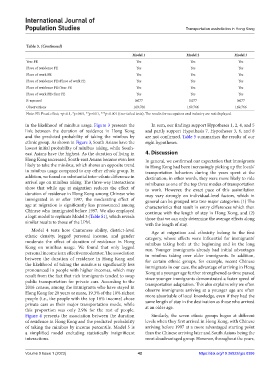
            Note: FE: Fixed effect; +p<0.1, *p<0.05, **p<0.01, ***p<0.001 (two-tailed tests); The results for occupation and industry are not displayed.
            in the likelihood of minibus usage. Figure 3 presents the   In sum, our findings support Hypotheses 1, 2, 4, and 5
            link between the duration of residence in Hong Kong   and partly support Hypothesis 7. Hypotheses 3, 6, and 8
            and the predicted probability of taking the minibus by   are not confirmed. Table 5 summarizes the results of our
            ethnic group. As shown in Figure 3, South Asians have the   eight hypotheses.
            lowest initial probability of minibus taking, while South-
            east Asians have the highest. As the duration of living in   4. Discussion
            Hong Kong increased, South-east Asians became even less   In general, we confirmed our expectation that immigrants
            likely to take the minibus, which shows an opposite trend   in Hong Kong had been increasingly picking up the locals’
            in minibus usage compared to any other ethnic group. In   transportation behaviors during the years spent at the
            addition, we found no substantial inter-ethnic difference in   destination; in other words, they were more likely to ride
            arrival age on minibus taking. The three-way interactions   minibuses as one of the top three modes of transportation
            show that while age at migration reduces the effect of   to work. However, the exact pace of this assimilation
            duration of residence in Hong Kong among Chinese who   may vary strongly on individual-level factors, which in
            immigrated in or after 1997, the moderating effect of   general can be grouped into two major categories: (1) The
            age at migration is significantly less pronounced among   characteristics that result in entry differences which then
            Chinese who immigrated before 1997. We also employed   continue with the length of stay in Hong Kong, and (2)
            a logit model to replicate Model 3 (Table S1), which reveals   those that we can only determine the average effects along
            similar results to those of the LPM.               with the length of stay.
              Model 4 tests how Cantonese ability, district-level   Age at migration and ethnicity belong to the first
            ethnic density, logged personal income, and gender   category, whose effects were influential for immigrants’
            moderate the effect of duration of residence in Hong   minibus taking both at the beginning and in the long
            Kong on minibus usage. We found that only logged   run. Younger immigrants already had initial advantages
            personal income is an effective moderator. The association   in minibus taking over older immigrants. In addition,
            between the duration of residence in Hong Kong and   for certain ethnic groups, for example, recent Chinese
            the likelihood of taking the minibus is significantly less   immigrants in our case, the advantage of arriving in Hong
            pronounced in people with higher incomes, which may   Kong at a younger age further strengthened as time passed
            result from the fact that rich immigrants tended to swap   since younger immigrants demonstrated a faster speed of
            public transportation for private cars. According to the   transportation adaptation. This also explains why we often
            2016 census, among the immigrants who have stayed in   observe immigrants arriving at a younger age are often
            Hong Kong for 20 years or more, 19.3% of the 10% richest   more absorbable of local knowledge, even if they had the
            people (i.e., the people with the top 10% income) chose   same length of stay in the destination as those who arrived
            private cars as their major transportation mode, while
            this proportion was only 2.9% for the rest of people.   at an older age.
            Figure  4 presents the association between the duration   Similarly,  the  seven  ethnic  groups  began  at  different
            of residence in Hong Kong and the predicted probability   levels when they first arrived in Hong Kong, with Chinese
            of taking the minibus by income percentile. Model 5 is   arriving before 1997 at a more advantaged starting point
            a simplified model excluding statistically insignificant   than the Chinese arriving later and South Asians being the
            interactions.                                      most disadvantaged group. However, throughout the years,


            Volume 9 Issue 1 (2023)                         42                        https://doi.org/10.36922/ijps.0386

