


Page 93 - IMO-2-1
P. 93
Innovative Medicines & Omics                                       Economical method for titering viral vectors


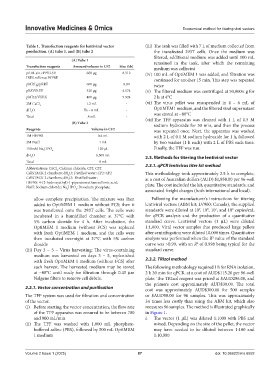
            Table 1. Transfection reagents for lentiviral vector   (iii) The tank was filled with 7 L of medium collected from
            production. (A) tube 1, and (B) tube 2                the transfected 293T cells. Once the medium was
                                                                  filtered, additional medium was added until 100 mL
                               (A) Tube 1                         remained in the tank, after which the remaining
            Transfection reagents  Amount/volume in CF2  Size (kb)  medium was collected
            pRRL.sin.cPPT.LSP.        600 µg         8.512     (iv)  100 mL of OptiMEM 1 was added, and filtration was
            IRES.mVenus.WPRE                                      continued for another 15 min. This step was repeated
            pMDLg/pRRE                600 µg          8.89        twice
            pRSV/REV                  320 µg         4.174     (v)  The filtered medium was centrifuged at 50,000× g for
            pMD2/VSV.G                400 µg         5.924        2 h at 4°C
            2M CaCl 2                 1.2 mL           -       (vi) The virus pellet was resuspended in 4 – 6  mL of
            dH O                     To – 8 mL         -          OptiMEM1 medium, and the filtered viral supernatant
              2
                                                                  was stored at −80°C
            Total                     8 mL             -       (vii) The TFF apparatus was cleaned with 1  L of 0.5 M
                                (B) Tube 2                        sodium hydroxide for 30 min, and then the process
            Reagents                    Volume in CF2             was repeated once. Next, the apparatus was washed
            1M HEPES                       0.4 mL                 with 2 L of 0.1 M sodium hydroxide for 1 h, followed
            2M NaCl                        1 mL                   by two washes (1 h each) with 2 L of PBS each time.
            150mM Na HPO 4                 120 µL                 Finally, the TFF was run.
                   2
            dH O                          6.508 mL
              2                                                2.3. Methods for titering the lentiviral vector
            Total                          8 mL
            Abbreviations: CaCl : Calcium chloride; CF2: CF2   2.3.1. qPCR lentivirus titer kit method
                         2
            CellSTACK 2 chambers; dH O: Distilled water; CF2: CF2   This methodology took approximately 2.5 h to complete,
                              2
            CellSTACK 2 chambers; dH O:  Distilled water;      at a cost of Australian dollars (AUD) $1,958.00 per 96-well
                              2
            HEPES: 4-(2-hydroxyethyl)-1-piperazineethanesulfonic acid;   plate. The cost included the kit, quantitative standards, and
            NaCl: Sodium chloride; Na HPO : Disodium phosphate.
                              2  4                             associated freight charges (both international and local).
               allow complete precipitation. The mixture was then   Following the manufacturer’s instructions for titering
               added to OptiMEM 1 medium without FCS; then it   lentiviral vectors (ABM kit; LV900; Canada), the supplied
                                                                                      9
                                                                                         8
                                                                                                    6
                                                                                             7
               was transferred onto the 293T cells. The cells were   standards were diluted at 10 , 10 , 10 , and 10  copies/mL
               incubated  in  a  humidified  chamber  at  37°C  with   for qPCR analysis and the production of a quantitative
               5% carbon dioxide for 4  h. After incubation, the   standard curve. Lentiviral vectors (1  µL) were diluted
               OptiMEM 1 medium (without FCS) was replaced     1:1,000. Viral vector samples that produced large pellets
               with fresh OptiMEM 1 medium, and the cells were   after centrifugation were diluted 10,000 times. Quantitative
               then incubated overnight at 37°C with 5% carbon   analysis was performed when the R  value of the standard
                                                                                           2
               dioxide                                         curve was >0.99, with an R  of 0.998 being typical for the
                                                                                     2
            (iii) Day 3 – 5 – Virus harvesting: The virus-containing   standard curve.
               medium was harvested on days 3 – 5, replenished
               with fresh OptiMEM 1 medium (without FCS) after   2.3.2. TRIzol method
               each harvest. The harvested medium may be stored   The following methodology required 1 h for RNA isolation,
               at −80°C until ready for filtration through 0.45  µm   2 h 30 min for qPCR, at a cost of AUD$115.20 per 96-well
               Nalgene filters to remove cell debris.          plate. The TRIzol reagent was priced at $AUD296.00, and
                                                               the primers cost approximately AUD$30.00. The total
            2.2.1. Vector concentration and purification       cost was approximately AUD$300.00 for 500  samples
            The TFF system was used for filtration and concentration   or $AUD58.00 for 96  samples. This was approximately
            of the vector.                                     34 times less costly than using the ABM kit, which also
            (i)  Before starting the vector concentration, the flow rate   measures 96 samples. The method is illustrated graphically
               of the TFF apparatus was ensured to be between 700   in Figure 1.
               and 900 mL/min                                  i.   The vector (1 µL) was diluted 1:1000 with PBS and
            (ii)  The TFF was washed with 1,000  mL phosphate-    mixed. Depending on the size of the pellet, the vector
               buffered saline (PBS), followed by 500 mL OptiMEM   may have needed to be diluted between 1:100 and
               1 medium                                           1:10,000


            Volume 2 Issue 1 (2025)                         87                               doi: 10.36922/imo.6552

