


Page 95 - IMO-2-1
P. 95
Innovative Medicines & Omics                                       Economical method for titering viral vectors


            (copies/mL) to generate a standard curve. The mean Ct   3. Results
            value for each sample was then interpolated on the standard
            curve to determine the copy number and titer (copies/mL).   3.1. Performance comparison of two lysis buffer
            If the samples had been diluted before PCR, the final   formulations for RNA preparations
            concentration and/or titer were adjusted according to the   The titers of vector stocks produced using either method
            appropriate dilution factor.                       were not significantly different. The titer obtained from
                                                               the ABM kit was 32.6 ± 8.9 × 10  transduction units
                                                                                             8
            2.4. Statistical analysis                          (TU)/mL, whereas the titer from the  TRIzol method
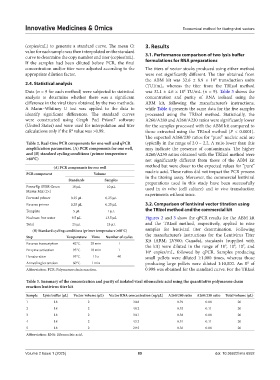
            Data (n = 9 for each method) were subjected to statistical   was 32.1 ± 4.6 × 10  TU/mL (n = 9). Table 3 shows the
                                                                               8
            analysis to determine whether there was a significant   concentration and purity of RNA isolated using the
            difference in the viral titers obtained by the two methods.   ABM kit, following the manufacturer’s instructions,
            A  Mann–Whitney U test was applied to the data to   while Table 4 presents the same data for the five samples
            identify significant differences. The standard curves   processed using the TRIzol method. Statistically, the
            were constructed using  Graph Pad Prism7 software   A260/A280 and A260/A230 ratios were significantly lower
            (United States) and were used for interpolation and titer   for the samples processed with the ABM kit compared to
            calculations only if the R  value was >0.99.       those extracted using the TRIzol method (P  < 0.0001).
                               2
                                                               The expected A260/230 ratios for “pure” nucleic acid are
            Table 2. Real‑time PCR components for one well and qPCR   typically in the range of 2.0 – 2.2. A ratio lower than this
            amplification parameters. (A) PCR components for one well,   may  indicate  the  presence  of  contaminants.  The  higher
            and (B) standard cycling conditions (primer temperature   A260/A230 ratios obtained with the TRIzol method were
            ≥60°C)                                             not significantly different from those of the ABM kit

                        (A) PCR components for one well        method but were closer to the expected values for “pure”
            PCR component                Volume                nucleic acid. These ratios did not impact the PCR process
                              Standards       Samples          in the titering assay. Moreover, the commercial lentiviral
                                                               preparations used in this study have been successfully
            PowerUp SYBR Green   10 µL        10 µL            used in  in vitro (cell  culture) and  in vivo transduction
            Master Mix (2×)                                    experiments without issue.
            Forward primer     0.25 µL        0.25 µL
            Reverse primer     0.25 µL        0.25 µL          3.2. Comparison of lentiviral vector titration using
            Template            5 µL           1 µL            the TRIzol method and the commercial kit
            Nuclease free water  9.5 µL       13.5 µL          Figures 2 and 3 show the qPCR results for the ABM kit
            Total               25 µL         25 µL            and the TRIzol method, respectively, applied to nine
               (B) Standard cycling conditions (primer temperature ≥60°C)  samples  for  lentiviral  titer  determination.  Following
            Step             Temperature  Time  Number of cycles  the  manufacturer’s  instructions for the  Lentivirus Titer
            Reverse transcription  42°C  20 min    1           Kit (ABM; LV900; Canada), standards (supplied with
                                                               the kit) were diluted in the range of 10 , 10 , 10 , and
                                                                                                        7
                                                                                                     8
                                                                                                 9
            Enzyme activation   95°C    10 min     1           10  copies/mL, followed by qPCR. Samples producing
                                                                 6
            Denaturation        95°C     15 s      40          small pellets were diluted 1:1,000  times, whereas those
            Annealing/extension  60°C   1 min                  producing large pellets were diluted 1:10,000. An  R  of
                                                                                                          2
            Abbreviation: PCR: Polymerase chain reaction.      0.998 was obtained for the standard curve. For the TRIzol
            Table 3. Summary of the concentration and purity of isolated viral ribonucleic acid using the quantitative polymerase chain
            reaction lentivirus titer kit
            Sample  Lysis buffer (µL)  Vector volume (µL)  Vector RNA concentration (ng/µL)  A260/280 ratio  A260/230 ratio  Total volume (µL)
            1           18            2                   30.8              0.39        0.08          20
            2           18            2                   48.2              0.53        0.11          20
            3           18            2                   30.1              0.38        0.08          20
            4           18            2                   43.3              0.51        0.11          20
            5           18            2                   29.5              0.36        0.08          20
            Abbreviation: RNA: Ribonucleic acid.


            Volume 2 Issue 1 (2025)                         89                               doi: 10.36922/imo.6552

