


Page 58 - IMO-2-3
P. 58
Innovative Medicines & Omics                                              Biocompatibility of nanomaterials


            key to minimizing long-term tissue damage and enhancing   Beyond biochemical cues, gene-activated scaffolds have
            scaffold integration. As shown in Figures 3 and 4, PLGA   emerged as a powerful tool, enabling the localized delivery
            modification alters the functional behavior of CaO–CaP   of therapeutic DNA or RNA to stimulate regenerative
            nanomaterials, while  subsequent scaffold degradation   pathways directly within the defect area. These platforms
            triggers a time-dependent inflammatory response marked   are gaining attention for their potential in treating complex
            by shifts in cytokine expression.                  and non-healing bone injuries, where conventional
            6.5. Emerging strategies for clinical translation  scaffolds often fall short.

            Translating CaO–CaP-based systems into clinical      A transformative shift is also underway with the adoption
            practice requires more than just demonstrating biological   of 3D printing technologies, allowing the fabrication
            compatibility; it also demands innovations in material   of  patient-specific  scaffolds  with  precise  anatomical
            design, delivery mechanisms, and scalable fabrication   conformity. This level of personalization improves not only
            methods. One notable advancement is the inclusion of   implant integration and mechanical performance but also
            osteogenic growth factors such as bone morphogenetic   healing outcomes. As part of our ongoing investigations,
            proteins (BMPs) and vascular endothelial growth factor   CaO–CaP scaffolds are being combined with bioactive
            (VEGF), which play key roles in promoting both osteoblast   molecules and additive manufacturing techniques to
            differentiation and vascularization of the implant site. 47  boost  regenerative  efficiency  while  enhancing  clinical
                                                               adaptability. 48
                                                                 In parallel, ion-doped biodegradable systems—
                                                               particularly those incorporating magnesium ions—are
                                                               showing great promise for bone repair. A recent study
                                                               by Tao et al.  described the successful development of
                                                                         49
                                                               porous PLA-based microspheres doped with magnesium,
                                                               which exhibited enhanced biocompatibility, improved
                                                               osteogenic potential, and controlled biodegradation.
            Figure 2. A series of reactions triggered by the surface modification of   These findings align with our own data, underscoring
            CaO–CaP. Adding PLGA coating changes the pH and affects the secretion   the importance of controlled ionic release and scaffold
            of pro-inflammatory cytokines. Image created by the author.
            Abbreviations: CaO:  Calcium  oxide;  CaP:  Calcium  phosphate;   adaptability in the clinical success of CaO–CaP
            PLGA: Poly(lactic-co-glycolic acid).               materials.


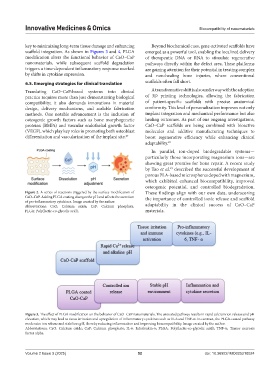
            Figure 3. The effect of PLGA modification on the behavior of CaO–CaP nanomaterials. The uncoated pathway results in rapid calcium ion release and pH
            elevation, which may lead to tissue irritation and upregulation of inflammatory cytokines such as IL-6 and TNF-α. In contrast, the PLGA-coated pathway
            moderates ion release and stabilizes pH, thereby reducing inflammation and improving biocompatibility. Image created by the author.
            Abbreviations: CaO: Calcium oxide; CaP: Calcium phosphate; IL-6: Interleukin-6; PLGA: Poly(lactic-co-glycolic acid); TNF-α: Tumor necrosis
            factor alpha.


            Volume 2 Issue 3 (2025)                         52                          doi: 10.36922/IMO025210024

