


Page 60 - IMO-2-3
P. 60
Innovative Medicines & Omics                                              Biocompatibility of nanomaterials


            Table 2. Comparative biocompatibility metrics of selected
            nanomaterials
            Nanomaterial Hemolysis  Complement  Circulation  Inflammatory
                       rate (%)  activation   half‑life   response
                               (C3a level)  (hours)  (IL‑6/IL‑1β)
            CaO–CaP      4.5   Moderate    6–8   Low (with
                                                 coating)
            AuNPs        2.1   Low        12–24  Minimal
            SiNPs        7.8   High        2–5   Elevated
            PLGA         3.3   Low         8–12  Minimal
            nanoparticles
            LNPs         1.2   Very low    24+   Negligible
            Abbreviations: AuNPs: Gold nanoparticles; CaO: Calcium oxide;
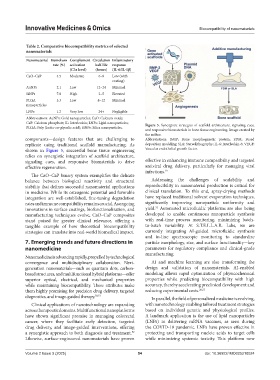
            CaP: Calcium phosphate; IL: Interleukin; LNPs: Lipid nanoparticles;   Figure 5. Synergistic strategies of scaffold architecture, signaling cues,
            PLGA: Poly (lactic-co-glycolic acid); SiNPs: Silica nanoparticles.
                                                               and responsive biomaterials in bone tissue engineering. Image created by
                                                               the author.
            components—design  features  that  are  challenging  to   Abbreviations: BMP: Bone morphogenetic protein; FDM: Fused
            replicate using traditional scaffold manufacturing. As   deposition modeling; SLA: Stereolithography; IL-6: Interleukin-6; VEGF:
            shown in  Figure  5, successful bone tissue engineering   Vascular endothelial growth factor.
            relies on synergistic integration of scaffold architecture,
            signaling cues, and responsive biomaterials to drive   effective in enhancing immune compatibility and targeted
            effective regeneration.                            antiviral drug delivery, particularly for managing viral
                                                               infections. 19
              The CaO–CaP binary system exemplifies the delicate
            balance between biological reactivity and structural   Addressing the challenges of scalability and
            stability that defines successful nanomaterial applications   reproducibility in nanomaterial production is critical for
            in medicine. While its osteogenic potential and favorable   clinical translation. To this end, spray-drying methods
            integration are well-established, fine-tuning degradation   have replaced traditional solvent evaporation techniques,
            rates and immune compatibility remains crucial. As ongoing   significantly improving nanoparticle uniformity and
                                                                   51
            innovations in surface coatings, biofunctionalization, and   yield.  Automated microfluidic platforms are also being
            manufacturing techniques evolve, CaO–CaP composites   developed to enable continuous nanoparticle synthesis
            stand poised for greater clinical relevance, offering a   with real-time process monitoring, minimizing batch-
            tangible example of how theoretical biocompatibility   to-batch  variability. At  S.T.E.L.L.A.R. Labs, we  are
            strategies can translate into real-world biomedical impact.  currently integrating AI-guided microfluidic synthesis
                                                               and in-line spectroscopic monitoring to standardize
            7. Emerging trends and future directions in        particle morphology, size, and surface functionality—key
            nanomedicine                                       parameters  for  regulatory  compliance  and  clinical-grade
                                                               manufacturing.
            Nanomedicine is advancing rapidly, propelled by technological
            convergence and multidisciplinary collaboration. Next-  AI and machine learning are also transforming  the
            generation nanomaterials—such as quantum dots, carbon-  design and validation of nanomaterials. AI-enabled
            based structures, and multifunctional hybrid platforms—offer   modeling allows rapid optimization of physicochemical
            superior optical, electrical, and mechanical properties   properties  while  predicting  biocompatibility  with  high
            while maintaining biocompatibility. These attributes make   accuracy, thereby accelerating preclinical development and
            them highly promising for precision drug delivery, targeted   reducing experimental costs. 26,53
            diagnostics, and image-guided therapy. 50,51         In parallel, the field of personalized medicine is evolving,
              Clinical applications of nanotechnology are expanding   with nanotechnology enabling tailored treatment strategies
            across therapeutic domains. Multifunctional nanoplatforms   based on individual genetic and physiological profiles.
            have shown significant promise in managing colorectal   A landmark application is the use of lipid nanoparticles
            cancer, where they facilitate early detection, targeted   (LNPs) in delivering mRNA vaccines, as seen during
            drug  delivery,  and  image-guided  interventions,  offering   the COVID-19 pandemic. LNPs have proven effective in
            a synergistic approach to both diagnosis and treatment.    protecting  and  transporting  nucleic  acids  to  target  cells
                                                         52
            Likewise, surface-engineered nanomaterials have proven   while minimizing systemic toxicity. This platform now

            Volume 2 Issue 3 (2025)                         54                          doi: 10.36922/IMO025210024

