


Page 94 - ITPS-8-3
P. 94
INNOSC Theranostics and
            Pharmacological Sciences                                                   Effects of robots on QoL in SCI


            Table 1. Descriptive characteristics of patients who   Table 2. Comparison of quality of life and patient
            underwent spinal surgery assisted with Tianji robot  satisfaction at pre‑surgery and two follow‑up points among
                                                               those who underwent Tianji robot surgery
            Variable                        n (%)  Mean±SD
            Gender                                             Scales      Pre‑surgery  6‑month   12‑month   p‑value
                                                                                      follow‑up  follow‑up
             Male                          124 (36.68)  -
                                                               ODI
             Female                        214 (63.31)  -
                                                                Pain intensity  76±2.76  48±7.98  32±4.28  0.012
            Age (years)                       -    63.76±14
                                                                Personal care  87±6.98  35±5.90  22±8.54  <0.001
            Surgical type
                                                                Lifting      83±7.46  62±3.75   58±6.73  0.045
             Robot-assisted closed reduction and internal  62 (18.34)  -
             fixation                                           Walking      79±3.65  58±9.65   44±3.54  0.005
             Robotic navigation-assisted   70 (20.71)  -        Sitting      77±4.98  54±2.65   49±6.32  0.032
             Robot-assisted balloon        47 (15.7)  -         Standing     88±4.43  76±8.56   63±5.42  0.028
             Robot-assisted percutaneous balloon   15 (4.43)  -  Sleeping    70±4.21  66±7.35   59±5.82  0.087
             dilatation                                         Social life  504±206.98  43±8.65  32±9.54  0.531
             5G remote robot-assisted closed reduction  6 (1.77)  -  Traveling  93±1.76  80±4.66  58±3.94  0.018
             Robot-assisted balloon vertebroplasty  7 (2.07)  -  Employment/  88±4.43  71±6.32  45±6.82  0.021
            Associated fractures                                homemaking
             Upper extremity fractures     93 (27.51)  -       SF-36
             Lower extremity fractures     166 (49.11)  -       PCS          34±5.87  51±3.23   79±4.78  0.014
             Others*                       79 (23.37)  -        MCS          53±2.54  75±5.87   89±4.82  0.067
            Fracture type                                      NSNCS         48±7.43  65±6.09   86±4.32  0.034
             Traumatic                     260 (76.92)  -      Abbreviations: MCS: Mental component summary; NSNCS: Newcastle
                                                               Satisfaction with Nursing Care Scale; ODI: Oswestry Disability Index;
             Non-traumatic                 78 (23.07)  -       PCS: Physical component summary; SF-36: Short Form Health
            Fracture region                                    Survey-36.
             Lumbar                        190 (56.21)  -
             Thoracic                      99 (29.28)  -
             Thoracolumbar                 33 (9.76)  -
             Cervical                      14 (4.14)  -
            Admission to surgery (days)       -    3.03±1.60
            Note: *Other fractures.
            Abbreviation: SD: Standard deviation.

            Among the 3  time points: Pre-surgery, 6-month, and
            12-month post-surgery, there were significant changes in
            the ODI scores over different categories, including pain
            intensity, personal care, lifting, walking, sitting, standing,
            traveling, and employment/homemaking. In addition,
            the physical component summary subscale of the SF-36
            scores showed significant differences throughout the
            three follow-up periods (p=0.014). In contrast, the mental
            component summary did not show any significant changes.
            The NSNCS scores showed significant changes throughout
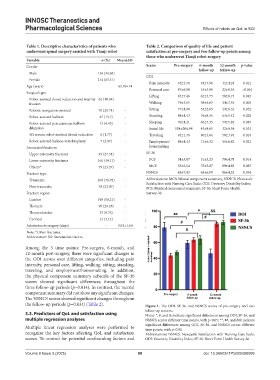
            the follow-up periods (p=0.034) (Table 2).         Figure 1. The ODI, SF-36, and NSNCS scores of pre-surgery and two
                                                               follow-up sessions
            3.3. Predictors of QoL and satisfaction using      Notes: *, #, and & indicate significant differences among ODI, SF-36, and
            multiple regression analyses                       NSNCS across different time points, with p<0.05; **, ##, and && indicate
            Multiple linear regression analyses were performed to   significant differences among ODI, SF-36, and NSNCS across different
                                                               time points, with p<0.01.
            recognize the key factors affecting QoL and satisfaction   Abbreviations: NSNCS: Newcastle Satisfaction with Nursing Care Scale;
            scores. To control for potential confounding factors and   ODI: Oswestry Disability Index; SF-36: Short Form Health Survey-36.


            Volume 8 Issue 3 (2025)                         88                          doi: 10.36922/ITPS025080009

