


Page 25 - JCAU-7-1
P. 25
Journal of Chinese
            Architecture and Urbanism                                                 Spatial syntax of temple heritage


               determine the relationship between local and overall   highest connection value, indicating a strong connection
               aspects of the village. Based on previous research,   with the village, significant spatial permeability, and
               comprehensibility can be roughly categorized into   a close spatial relationship. Axis 1, along with several
               four levels: high (0.7 ≤ R ), average (0.4 ≤ R  < 0.7), low   directly connected axes, forms the core of the Baiyu
                                                 2
                                  2
               (0.2 ≤ R  < 0.4), and extremely low (R² < 0.2) (Hegazi   Temple  settlement,  extending  from  south  to north in  a
                      2
               et al., 2022). The calculation method is as shown in   distinct linear pattern. Axes 2, 3, 4, and 5 also exhibit high
               Equation III.                                   connection values, indicating strong spatial permeability
                 [   I (   I ’  )( I   I ’  )]              and close spatial  connections to  the village.  The village
            R        3   3   n   n            (III)   road network features numerous irregular streets and
             2
                  I (  3    I ’  ) 2  I (  n    I ’  n  ) 2  alleys, resulting in complex and diverse connections with
                         3
                                                               poor spatial permeability. This area is less accessible to
              Where I  i the local integration value when the number   outsiders due to the high density of residential buildings,
                     (3)
            of steps  n  = 3,  I’  is the average integration degree for   contributing to its relative seclusion.
                          (3)
            three steps, I  is the global integration value, and I’  is the   4.1.2. Integration degree
                                                    (n)
                      (n)
            average global integration degree.
                                                               The global integration degree signifies the extent of
              For this study, Depthmap software was employed as   interconnection between an axis and other axes, thereby
            the key tool for spatial syntax analysis. This software is   reflecting the ease of access to a specific space. A higher
            renowned for its comprehensive analysis methods and   global integration degree correlates with enhanced spatial
            consistent performance, making it the preferred choice for   accessibility within the region. Utilizing Depthmap
            spatial syntax analysis. Its suitability for meso to microscale   software, we generated a global integration axis map
            applications makes it ideal for this particular analysis.   (depicted in Figure 5). On this map, the intensity of the axis
            In addition, CAD was used for creating the necessary   colors corresponds to the degree of spatial integration: red,
            drawings.                                          orange, and yellow hues denote core areas with high global
            4. Spatial morphology analysis based on            integration. These highly integrated axes are predominantly
            spatial syntax                                     aligned with the main roads parallel to the river and key
                                                               nodes, exhibiting pronounced linear characteristics that
            4.1. Baiyu temple                                  underscore the pivotal role of the village’s public spaces in
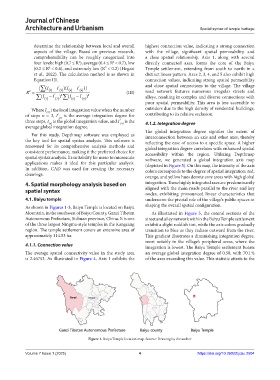
            As shown in Figures 1-3, Baiyu Temple is located on Baiyu   shaping the overall spatial configuration.
            Mountain, in the southwest of Baiyu County, Ganzi Tibetan   As illustrated in  Figure  5, the central sections of the
            Autonomous Prefecture, Sichuan province, China. It is one   street and alley network within the Baiyu Temple settlement
            of the three largest Ningma-style temples in the Kangzang   exhibit a slight reddish tint, while the axis colors gradually
            region. The temple settlement covers an extensive area of   transition to blue as they radiate outward from the river.
            approximately 114.53 ha.                           This gradient illustrates a diminishing integration degree,
                                                               most notably in the village’s peripheral areas, where the
            4.1.1. Connection value                            integration is lowest. The Baiyu Temple settlement boasts
            The average spatial connectivity value in the study area   an average global integration degree of 0.58, with 70.1%
            is 2.46753. As illustrated in Figure 4, Axis 1 exhibits the   of the axes exceeding this value. This statistic attests to the


                                       Figure 1. Baiyu Temple location map. Source: Drawing by the author


            Volume 7 Issue 1 (2025)                         4                        https://doi.org/10.36922/jcau.2504

