


Page 35 - JCBP-1-2
P. 35
Journal of Clinical and
            Basic Psychosomatics                                                 Satisfaction of home-school cooperation


            Table 1. Means, standard deviations, and Spearman’s correlation coefficient for each variable
             Variables          M        SD         1           2          3           4          5         6
            Parents’ satisfaction  59.04  9.43      —
            Mental resilience  52.68    11.35     0.25***      —
            Education anxiety  43.77    13.96     −0.24***   −0.33***      —
            Rejection          9.36      3.47     −0.30***    −0.18**    0.23***       —
            Emotional warmth   19.53     4.77     0.22***     0.42***    −0.22***    −0.36***     —
            Overprotection     16.48     3.80     −0.26***    −0.16**    0.26***     0.71***    −0.19**    —
            Note: *p<0.05, **p<0.01, ***p<0.001

            Table 2. Regression analysis in the models for each variable

             Predicting       Model 1 (Education anxiety)  Model 2 (Emotional warmth)  Model 3 (mental resilience)
             variables        β            t               β             t           β               t
            Parents’ satisfaction  −0.237  −4.461***      0.176        3.249**      0.123          2.469*
            Education anxiety                             −0.179      −3.304**     −0.228         −4.595***
            Emotional warmth                                                        0.344         6.953***
            R 2                       0.056                     0.078                        0.252
            F                        19.904***                 14.080***                    37.228***
            Note: *p<0.05, **p<0.01, ***p<0.001

            Table 3. Standardized indirect effects and 95% confidence
            intervals
             Path            Estimated   95%CI     Effect size
            X→M1→Y             0.07     [0.03,0.12]  43.75%
            X→M2→Y             0.07     [0.03,0.13]  43.75%
            X→M1→M2→Y          0.02     [0.00,0.04]  12.50%
            Total indirect effects  0.16  [0.10,0.22]  100%
            Estimated was the standardized indirect effect of each mediate
            pathway; effect size was calculated by using the ratio of the total effect
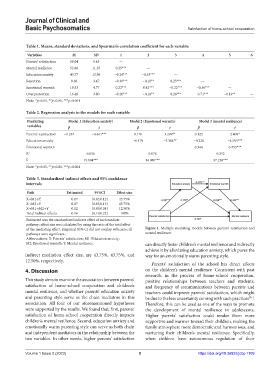
            of the mediating effect. Empirical 95% CI did not overlap with zero; all   Figure 1. Multiple mediating models between parents’ satisfaction and
            pathways were significant.                         mental resilience.
            Abbreviations: X: Parents’ satisfaction; M1: Education anxiety;
            M2: Emotional warmth; Y: Mental resilience.        can directly foster children’s mental resilience and indirectly
                                                               achieve it by alleviating education anxiety, which paves the
            indirect  mediation  effect  size,  are  43.75%,  43.75%,  and   way for an emotionally warm parenting style.
            12.50%, respectively.
                                                                 Parents’ satisfaction of the school has direct effects
            4. Discussion                                      on the children’s mental resilience. Consistent with past
                                                               research,  in  the process of  home-school cooperation,
            This study aims to examine the association between parents’   positive  relationships  between  teachers  and  students,
            satisfaction of home-school cooperation and children’s   and frequency of communications between parents and
            mental resilience, and whether parents’ education anxiety   teachers could improve parents’ satisfaction, which might
            and parenting style serve as the chain mediators in this   be due to the less uncertainty coming with such practices .
                                                                                                           [41]
            association. All four of our aforementioned hypotheses   Therefore, this can be used as one of the ways to promote
            were supported by the results. We found that, first, parents’   the development of mental resilience in adolescents.
            satisfaction of home-school cooperation directly impacts   Higher parents’ satisfaction could render them more
            children’s mental resilience. Second, education anxiety and   supportive and warmer toward their children, making the
            emotionally warm parenting style can serve as both chain   family atmosphere more democratic and harmonious, and
            and independent mediators in the relationship between the   nurturing their children’s mental resilience. Specifically,
            two variables. In other words, higher parents’ satisfaction   when children have autonomous regulation of their


            Volume 1 Issue 2 (2023)                         5                        https://doi.org/10.36922/jcbp.1109

