


Page 69 - JCBP-3-1
P. 69
Journal of Clinical and
            Basic Psychosomatics                                                           Protein and sleep problem


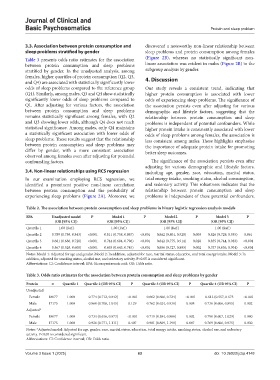
            3.3. Association between protein consumption and   discovered a noteworthy non-linear relationship between
            sleep problems stratified by gender                sleep problems and protein consumption among females
            Table 3 presents odds ratio estimates for the association   (Figure  2B), whereas no statistically significant non-
            between protein consumption and sleep problems     linear association was evident in males (Figure 2B) in the
            stratified by gender. In the unadjusted analysis, among   subgroup analysis by gender.
            females, higher quartiles of protein consumption (Q2, Q3,   4. Discussion
            and Q4) are associated with statistically significantly lower
            odds of sleep problems compared to the reference group   Our study reveals a consistent trend, indicating that
            (Q1). Similarly, among males, Q3 and Q4 show statistically   higher protein consumption is associated with lower
            significantly lower odds of sleep problems compared to   odds of experiencing sleep problems. The significance of
            Q1. After adjusting for various factors, the association   the association persists even after adjusting for various
            between protein consumption and sleep problems     demographic and lifestyle factors, suggesting that the
            remains statistically significant among females, with Q2   relationship between protein consumption and sleep
            and Q3 showing lower odds, although Q4 does not reach   problems is independent of potential confounders. While
            statistical significance. Among males, only Q4 maintains   higher protein intake is consistently associated with lower
            a statistically significant association with lower odds of   odds of sleep problems among females, the association is
            sleep problems. These results suggest that the relationship   less consistent among males. These highlights emphasize
            between protein consumption and sleep problems may   the importance of adequate protein intake for promoting
            differ by gender, with a more consistent association   better sleep outcomes.
            observed among females even after adjusting for potential
            confounding factors.                                 The significance of the association persists even after
                                                               adjusting for various demographic and lifestyle factors,
            3.4. Non-linear relationships using RCS regression  including  age,  gender,  race, education,  marital  status,
            In  our examination  employing  RCS  regression, we   total energy intake, smoking status, alcohol consumption,
            identified  a  prominent  positive  non-linear  correlation   and sedentary activity. This robustness indicates that the
            between protein consumption and the probability of   relationship between protein consumption and sleep
            experiencing sleep problems (Figure  2A). Moreover, we   problems is independent of these potential confounders.

            Table 2. The association between protein consumption and sleep problems in binary logistic regression analysis models

            EPA        Unadjusted model   P      Model 1      P        Model 2      P        Model 3      P
                        (OR [95% CI])          (OR [95% CI])         (OR [95% CI])         (OR [95% CI])
            Quartile 1    1.00 (Ref.)           1.00 (Ref.)            1.00 (Ref.)          1.00 (Ref.)
            Quartile 2  0.789 (0.739, 0.843)  <0.001  0.811 (0.758, 0.867)  <0.001  0.862 (0.801, 0.928)  0.003  0.826 (0.729, 0.935)  0.061
            Quartile 3  0.681 (0.636, 0.728)  <0.001  0.744 (0.694, 0.796)  <0.001  0.842 (0.775, 0.914)  0.028  0.855 (0.744, 0.983)  <0.001
            Quartile 4  0.567 (0.529, 0.608)  <0.001  0.693 (0.645, 0.745)  <0.001  0.806 (0.727, 0.893)  0.002  0.757 (0.636, 0.901)  <0.001
            Notes: Model 1: Adjusted for age and gender. Model 2: In addition, adjusted for race, marital status, education, and total energy intake. Model 3: In
            addition, adjusted for smoking status, alcohol use, and sedentary activity. P<0.05 is considered significant.
            Abbreviations: CI: Confidence interval; EPA: Eicosapentaenoic acid; OR: Odds ratio.

            Table 3. Odds ratio estimates for the association between protein consumption and sleep problems by gender

            Protein    n    Quartile 1  Quartile 2 (OR 95% CI)  P  Quartile 3 (OR 95% CI)  P  Quartile 4 (OR 95% CI)  P
            Unadjusted
             Female   18077   1.000    0.774 (0.712, 0.842)  <0.001  0.662 (0.606, 0.724)  <0.001  0.613 (0.557, 0.675  <0.001
             Male     17175   1.000    0.860 (0.708, 1.045)  0.129  0.762 (0.624, 0.930)  0.008  0.736 (0.606, 0.895)  0.002
            Adjusted*
             Female   18077   1.000    0.734 (0.616, 0.873)  <0.001  0.719 (0.584, 0.886)  0.002  0.790 (0.607, 1.029)  0.080
             Male     17175   1.000    0.926 (0.771, 1.111)  0.407  0.981 (0.809, 1.190)  0.847  0.769 (0.606, 0.975)  0.030
            Notes: *Adjusted model: Adjusted for age, gender, race, marital status, education, total energy intake, smoking status, alcohol use, and sedentary
            activity. P<0.05 is considered significant.
            Abbreviations: CI: Confidence interval; OR: Odds ratio.


            Volume 3 Issue 1 (2025)                         63                              doi: 10.36922/jcbp.4148

