


Page 100 - JCBP-3-3
P. 100
Journal of Clinical and
            Basic Psychosomatics                                          Sensitivity, self-esteem, and affective dependence


            p<0.001) and negative correlations between the HSPS-FR   affective dependence, where the model is significant and
            and the RSES (r = −0.485,  p<0.001) and between the   explains approximately 15% of the variance (r  = 0.145,
                                                                                                     2
            RSES and the ADS-9 (r = −0.395, p<0.001) (Table 4). All   F [1, 98] = 16.667, p<0.001) (Table 6).
            components of the HSPS are positively correlated with
            each other (p<0.005). The components of the RSES are   3.4. Mediation effect of the RSES between the HSPS
            positively correlated with each other (p<0.001), as are the   and the affective dependence scale
            components of the ADS-9 (p<0.001). The components of   The  overall  model  shows  that  both  SPS  and  self-
            the different constructs were also correlated with each other,   esteem influence affective dependence (p<0.001). The
            except for the AES component, which was not correlated   standardized indirect effect of HSPS-FR on ADS-9 though
            with any of the components of affective dependence, nor   RSES is significant (z = 4.083, p<0.001) (Table 7). In other
            with the self-competence component of self-esteem, which   words, SPS increases affective dependence through a
            was not correlated with the CHA component.         double negative effect: first, HSPS negatively impacts self-
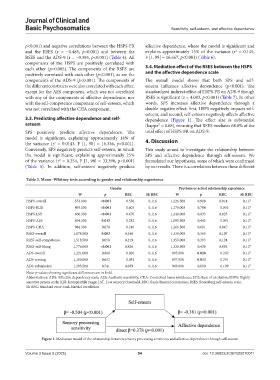
                                                               esteem, and second, self-esteem negatively affects affective
            3.3. Predicting affective dependence and self-     dependence (Figure  1). The effect size is substantial
            esteem                                             (kappa² = 0.68), meaning that RSES mediates 68.8% of the
            SPS positively predicts affective dependence. The   total effect of HSPS-FR on ADS-9.
            model  is  significant, explaining  approximately  14% of
            the variance (r  = 0.0143, F [1, 98] = 16.336,  p<0.001).   4. Discussion
                        2
            Conversely, SPS negatively predicts self-esteem, in which   This study aimed to investigate the relationship between
            the model is significant, explaining approximately 25%   SPS and affective dependence through self-esteem. We
            of the variance (r  = 0.254, F [1, 98] = 33.390, p<0.001)   formulated our hypotheses, some of which were confirmed
                          2
            (Table  5). In addition, self-esteem negatively predicts   by our results. There is a correlation between these different

            Table 3. Mann–Whitney tests according to gender and relationship experience
                                                Gender                       Previous or actual relationship experience
                                  W          p        RBC      SE RBC       W         p       RBC      SE RBC
            HSPS-overall         553.000    <0.001    −0.556    0.116     1,226.500  0.908    0.014     0.117
            HSPS-EOE             495.000    <0.001    −0.603    0.116     1,170.000  0.784    −0.033    0.117
            HSPS-LST             660.500    <0.001    −0.470    0.116     1,240.000  0.833    0.025     0.117
            HSPS-AES             894.000    0.015     −0.282    0.116     1,099.500  0.442    −0.091    0.117
            HSPS-CHA             984.500    0.070     −0.210    0.116     1,266.500  0.691    0.047     0.117
            RSES-overall        1,678.500   0.003     0.348     0.116     1,339.000  0.365    0.107     0.117
            RSES-self-competence  1,518.500  0.058    0.219     0.116     1,359.000  0.293    0.124     0.117
            RSES-self-liking    1,776.000   <0.001    0.426     0.116     1,320.500  0.438    0.092     0.117
            ADS-overall         1,221.000   0.868     −0.020    0.116     895.000    0.028    −0.260    0.117
            ADS-craving         1,180.000   0.652     −0.053    0.116     857.000    0.013    −0.291    0.117
            ADS-submission      1,293.500   0.741     0.039     0.116     969.000    0.090    −0.199    0.117
            Note: p-values showing significant differences are in bold.
            Abbreviations: ADS: Affective dependency scale; AES: Aesthetic sensitivity; CHA: Controlled harm avoidance; EOE: Ease of excitation; HSPS: Highly
            sensitive person scale; IQR: Interquartile range; LST: Low sensory threshold; RBC: Rank-biserial correlation; RSES: Rosenberg self-esteem scale;
            SE RBC: Standard error rank-biserial correlation.


                   Figure 1. Mediation model of the relationship between sensory processing sensitivity and affective dependence through self-esteem


            Volume 3 Issue 3 (2025)                         94                         doi: 10.36922/JCBP025070011

