


Page 101 - JCBP-3-3
P. 101
Journal of Clinical and
            Basic Psychosomatics                                          Sensitivity, self-esteem, and affective dependence


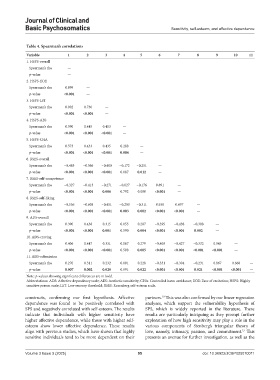
            Table 4. Spearman’s correlations
            Variable          1       2       3      4       5      6        7       8       9      10     11
            1. HSPS-overall
             Spearman’s rho   —
             p-value          —
            2. HSPS-EOE
             Spearman’s rho  0.899    —
             p-value        <0.001    —
            3. HSPS-LST
             Spearman’s rho  0.902   0.730    —
             p-value        <0.001  <0.001    —
            4. HSPS-AES
             Spearman’s rho  0.590   0.445   0.403   —
             p-value        <0.001  <0.001  <0.001   —
            5. HSPS-CHA
             Spearman’s rho  0.573   0.433   0.435  0.288    —
             p-value        <0.001  <0.001  <0.001  0.004    —
            6. RSES-overall
             Spearman’s rho  −0.485  −0.566  −0.400  −0.172  −0.251  —
             p-value        <0.001  <0.001  <0.001  0.087   0.012   —
            7. RSES-self-competence
             Spearman’s rho  −0.327  −0.413  −0.271  −0.027  −0.176  0.891   —
             p-value        <0.001  <0.001   0.006  0.792   0.080  <0.001    —
            8. RSES-self-liking
             Spearman’s rho  −0.556  −0.608  −0.451  −0.290  −0.311  0.938  0.697    —
             p-value        <0.001  <0.001  <0.001  0.003   0.002  <0.001  <0.001    —
            9. ADS-overall
             Spearman’s rho  0.390   0.438   0.315  0.055   0.287  −0.395  −0.438  −0.308    —
             p-value        <0.001  <0.001   0.001  0.590   0.004  <0.001  <0.001   0.002    —
            10. ADS-craving
             Spearman’s rho  0.406   0.447   0.331  0.067   0.279  −0.403  −0.427  −0.332   0.943    —
             p-value        <0.001  <0.001  <0.001  0.508   0.005  <0.001  <0.001  <0.001  <0.001    —
            11. ADS-submission
             Spearman’s rho  0.270   0.311   0.232  0.001   0.228  −0.331  −0.394  −0.231   0.867   0.668  —
             p-value         0.007   0.002   0.020  0.991   0.022  <0.001  <0.001   0.021  <0.001  <0.001  —
            Note: p-values showing significant differences are in bold.
            Abbreviations: ADS: Affective dependency scale; AES: Aesthetic sensitivity; CHA: Controlled harm avoidance; EOE: Ease of excitation; HSPS: Highly
            sensitive person scale; LST: Low sensory threshold; RSES: Rosenberg self-esteem scale.

            constructs, confirming our first hypothesis. Affective   partners.  This was also confirmed by our linear regression
                                                                      19
            dependence was found to be positively correlated with   analyses, which support the vulnerability hypothesis of
            SPS and negatively correlated with self-esteem. The results   SPS, which is widely reported in the literature. These
            indicate that individuals with higher sensitivity have   results are particularly intriguing as they prompt further
            higher affective dependence, while those with higher self-  exploration of how high sensitivity may play a role in the
            esteem  show lower affective dependence.  These results   various components of Stenberg’s triangular theory of
            align with previous studies, which have shown that highly   love, namely, intimacy, passion, and commitment.  This
                                                                                                        27
            sensitive individuals tend to be more dependent on their   presents an avenue for further investigation, as well as the


            Volume 3 Issue 3 (2025)                         95                         doi: 10.36922/JCBP025070011

