


Page 102 - JCBP-3-3
P. 102
Journal of Clinical and
            Basic Psychosomatics                                          Sensitivity, self-esteem, and affective dependence


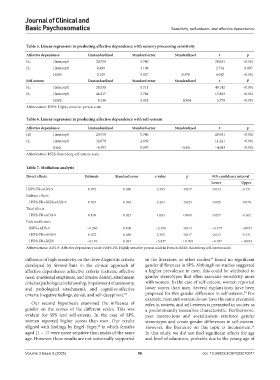
            Table 5. Linear regression in predicting affective dependence with sensory processing sensitivity
            Affective dependence      Unstandardized     Standard error    Standardized       t           p
            H₀          (Intercept)       20.750             0.740                           28.031      <0.001
            H₁          (Intercept)       8.499              3.108                           2.734       0.007
                        HSPS              0.109              0.027            0.378          4.042       <0.001
            Self‑esteem               Unstandardized     Standard error    Standardized       t           P
            H₀          (Intercept)       28.530             0.711                           40.142      <0.001
            H₁          (Intercept)       44.217             2.784                           15.883      <0.001
                        HSPS              −0.140             0.024            −0.504        −5.778       <0.001
            Abbreviation: HSPS: Highly sensitive person scale.

            Table 6. Linear regression in predicting affective dependence with self‑esteem
            Affective dependence      Unstandardized     Standard error    Standardized       t           p
            H0          (Intercept)       20.750             0.740                           28.031      <0.001
            H₁          (Intercept)       32.079             2.859                           11.221      <0.001
                        RSES              −0.397             0.097            −0.381        −4.083       <0.001
            Abbreviation: RSES: Rosenberg self-esteem scale.


            Table 7. Mediation analysis
            Direct effects           Estimate     Standard error   z‑value      p          95% confidence interval
                                                                                           Lower        Upper
            HSPS-FR→ADS-9              0.072         0.030          2.393      0.017       0.013        0.131
            Indirect effects
             HSPS-FR→RSES→ADS-9        0.037         0.016          2.264      0.024       0.005        0.070
            Total effects
             HSPS-FR→ADS-9             0.109         0.027          4.083      <0.001      0.057        0.162
            Path coefficients
             RSES→ADS-9               −0.266         0.108         −2.456      0.014       −0.479       −0.054
             HSPS-FR→ADS-9             0.072         0.030          2.393      0.017       0.013        0.131
             HSPS-FR→RSES             −0.140         0.024         −5.837      < 0.001     −0.187       −0.093
            Abbreviations: ADS-9: Affective dependency scale; HSPS-FR: Highly sensitive person scale in French; RSES: Rosenberg self-esteem scale.

            influence of high sensitivity on the three diagnostic criteria   in the literature, as other studies  found no significant
                                                                                          29
            developed by Sirvent-Ruiz in the clinical approach of   gender differences in SPS. Although no studies suggested
            affective dependence: addictive criteria (extreme affective   a higher prevalence in men, this could be attributed to
            need, emotional emptiness, and intense desire), attachment   gender stereotypes that often associate sensitivity more
            criteria (pathological relationship, impairment of autonomy,   with women. In the case of self-esteem, women reported
            and pathological attachment), and cognitive-affective   lower scores than men. Several explanations have been
                                                                                                         30
            criteria (negative feelings, denial, and self-deception). 26  proposed for this gender difference in self-esteem.  For
                                                               example, men and women do not have the same presumed
              Our second hypothesis examined the influence of   roles in society, and self-esteem is presented in society as
            gender on the scores of the different scales. This was   a predominantly masculine characteristic. Furthermore,
            evident for SPS and self-esteem. In the case of SPS,   peer interactions and socialization reinforce gender
            women reported higher scores than men. Our results   stereotypes and create gender differences in self-esteem.
            aligned with findings by Engel-Yeger,  in which females   However, the literature on this topic is inconsistent.
                                           28
                                                                                                            31
            aged 11 – 17 were more sensitive than males of the same   In this study, we did not find significant effects for age
            age. However, these results are not universally supported   and level of education, probably due to the young age of

            Volume 3 Issue 3 (2025)                         96                         doi: 10.36922/JCBP025070011

