


Page 88 - JCBP-3-3
P. 88
Journal of Clinical and
            Basic Psychosomatics                                                            Impact of seizures on life


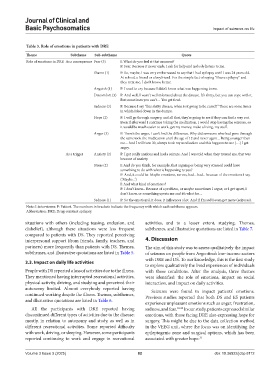
            Table 3. Role of emotions in patients with DRE
            Theme              Subtheme  Sub‑subtheme                         Quote
            Role of emotions in DRE As a consequence Fear (3)  I: What do you feel at that moment?
                                                    P: Fear. Because it never ends. I ask for help and nobody listens to me.
                                         Shame (1)  P: So, maybe, I was very embarrassed to say that I had epilepsy until I was 24 years old.
                                                    At school, a friend or a boyfriend. For the simple fact of saying “I have epilepsy” and
                                                    they treat me, I don’t know, better.
                                         Anguish (1)  P: I used to cry because I didn’t know what was happening to me.
                                         Discomfort (3)  P: And well, I wasn’t well informed about the disease. It’s shitty, but you can cope with it.
                                                    But sometimes you can’t… You get tired.
                                         Sadness (3)  P: Because I say “this shitty disease, when is it going to be cured?” There are some times
                                                    in which I feel down in the dumps.
                                         Hope (2)   P: I will go through surgery, and all that, they’re going to see if they can find a way out.
                                                    Even if afterward I continue taking the medication, I would stop having the seizures, so
                                                    it would be much easier to work, get my money, make a living, my stuff.
                                         Anger (3)  P: There’s the anger, I can’t find the difference. Why did someone who had gone through
                                                    the same took the medication until the age of 12 and never again... Being younger than
                                                    me... And I will turn 30, always took my medication and this happens to me (…) I get
                                                    angry.
                             As a trigger  Anxiety (2)  P: I got really anxious and had a seizure. And I was told when they treated me, that was
                                                    because of anxiety.
                                         Stress (2)  I: And do you think, for example, that arguing or being very stressed could have
                                                    something to do with what is happening to you?
                                                    P: And, it could be. Maybe emotions, nerves, bad... bad... because of the emotions I say.
                                                    (‘Maybe...’)
                                                    I: And what kind of emotions?
                                                    P: I don’t know... Because of a problem, or maybe sometimes I argue, or I get upset, I
                                                    don’t know, or something upsets me and it’s what for…
                                         Sadness (1)  P: So the emotional, it does, it influences a lot. And if I’m sad I even get more (seizures).
            Note: I: interviewer. P: Patient. The numbers in brackets indicate the frequency with which each subtheme appears.
            Abbreviation: DRE: Drug-resistant epilepsy.
            situations with others (including teasing, exclusion, and   activities, and to a lesser extent, studying. Themes,
            disbelief), although these situations were less frequent   subthemes, and illustrative quotations are listed in Table 7.
            compared to patients with DS. They reported perceiving
            interpersonal support (from friends, family, teachers, and   4. Discussion
            partners) more frequently than patients with DS. Themes,   The aim of this study was to assess qualitatively the impact
            subthemes, and illustrative quotations are listed in Table 5.  of seizures on people from Argentina’s low-income sectors
                                                               with DRE and DS. To our knowledge, this is the first study
            3.3. Impact on daily life activities
                                                               to explore qualitatively the lived experiences of individuals
            People with DS reported a loss of activities due to the illness.   with  these  conditions.  After  the  analysis,  three  themes
            They mentioned having interrupted recreational activities,   were identified: the role of emotions, impact on social
            physical activity, driving, and studying and perceived their   interaction, and impact on daily activities.
            autonomy limited. Almost everybody reported having   Seizures were found to impact patients’ emotions.
            continued working despite the illness. Themes, subthemes,   Previous studies reported that both DS and ES patients
            and illustrative quotations are listed in Table 6.
                                                               experience unpleasant emotions such as anger, frustration,
              All the participants with DRE reported having    sadness, and fear. 18-20  In our study, patients expressed similar
            discontinued different types of activities due to the disease:   emotions, with those facing DRE also expressing hope for
            mostly, in relation to autonomy and study, as well as in   surgery. This might be due to the data collection method
            different recreational activities. Some reported difficulty   in the VEEG unit, where the focus was on identifying the
            with work, driving, or sleeping. However, some participants   epileptogenic zone and surgical options, which has been
            reported continuing to work and engage in recreational   associated with greater hope. 31


            Volume 3 Issue 3 (2025)                         82                              doi: 10.36922/jcbp.8112

