


Page 89 - JCBP-3-3
P. 89
Journal of Clinical and
            Basic Psychosomatics                                                            Impact of seizures on life


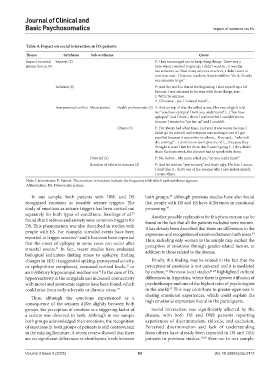
            Table 4. Impact on social interaction in DS patients
            Theme           Subtheme    Sub‑subtheme                                  Quote
            Impact on social  Support (2)                          P: They encouraged me to keep doing things. There was a
            interaction in DS                                      time when I wanted to give up, I didn’t want to... it was the
                                                                   last semester, as I had many seizures at school, I didn’t want to
                                                                   continue and... However, teachers, friends told me “do it, it’s only
                                                                   one semester to go.”
                         Isolation (4)                             P: And the truth is that at the beginning I shut myself up a bit
                                                                   because I was ashamed to be seen with those things, errr…
                                                                   I: With the seizures.
                                                                   P: Of course... yes, I isolated myself...
                         Interpersonal conflict Mistreatment  Health professionals (2) P: And on top of that she yelled at me, (the neurologist) told
                                                                   me “you have epilepsy! Don’t you understand? (...) You have
                                                                   epilepsy!” and I froze... there I realized that I couldn’t move,
                                                                   because I wanted to “eat her up” and I couldn’t.
                                                   Others (3)      P: I’ve always had a bad time. Last year it was worse because I
                                                                   didn’t go (to school) and everyone was waiting to see if I got
                                                                   expelled because it was unfair to others... They said... “why isn’t
                                                                   she coming?”... I don’t know. don’t piss me off (...) because they
                                                                   thought it wasn’t fair for them that I wasn’t going (...) they didn’t
                                                                   share the homework, the director had to speak with them.
                                       Disbelief (2)               P: No, before…My mum asked me, “do you really faint?”
                                       Reaction of others to seizures (2)  P: And he told me “you’re scary,” and that’s ugly. The fear. I mean,
                                                                   I don’t like it... that’s one of the reasons why I also isolate myself,
                                                                   I scare others.
            Note: I: interviewer. P: Patient. The numbers in brackets indicate the frequency with which each subtheme appears.
            Abbreviation: DS: Dissociative seizure.


              In our sample, both patients with DRE and DS     both groups,  although previous studies have also found
                                                                         38
            recognized emotions as possible seizure triggers. The   that people with DS and ES have differences in emotional
            study of emotions as seizure triggers has been carried out   processing. 39
            separately for both types of conditions. Rawlings  et al.    Another possible explanation for this phenomenon can be
                                                         32
            found that tiredness and anxiety were common triggers for   found in the fact that all the patients included were women.
            DS. This phenomenon was also described in studies with   It has already been described that there are differences in the
            people with ES. For example, stressful events have been   expression and recognition of emotions between both sexes.
                                                                                                            40
            reported to trigger seizures  and it has even been reported   Thus, including only women in the sample may explain the
                                 33
            that the onset of epilepsy in some cases can occur after   perception of emotions through gender-related factors, in
            stressful events.  In fact, recent studies have evaluated   addition to those related to the disease.
                         34
            biological indicators linking stress to epilepsy, finding
            changes in EEG (exaggerated spiking, paroxysmal activity,   Finally, this finding may be related to the fact that the
            or epileptiform complexes), increased cortisol levels,  or   perception of emotions is not universal and it is mediated
                                                       35
            an inhibitory hippocampal mechanism  In the case of DS,   by culture.  Previous local studies 21,23  highlighted cultural
                                                                       41
                                           36
            hyperreactivity in the amygdala and increased connectivity   differences in Argentina, where there is greater diffusion of
            with motor and autonomic regions have been found, which   psychotherapy and one of the highest rates of psychologists
                                                                         42
            could arise from early adversity or chronic stress. 37  in the world.  This may contribute to greater openness in
                                                               sharing emotional experiences, which could explain the
              Thus, although the emotions experienced as a
            consequence of the seizures differ slightly between both   high emotional expression found in the participants.
            groups, the perception of emotion as a triggering factor of   Social interaction was significantly affected by the
            a seizure was observed in both. Although in our sample   disease, with both DS and DRE patients reporting
            both groups acknowledged their emotions, the recognition   experiences of discrimination, ridicule, and exclusion.
            of emotions in both groups of patients is still controversial   Perceived discrimination and lack of understanding
            in the existing literature. A recent review showed that there   from others have already been reported in DS and DRE
            are no significant differences in alexithymia levels between   patients in previous studies. 19,20  Even so, in our sample,


            Volume 3 Issue 3 (2025)                         83                              doi: 10.36922/jcbp.8112

