


Page 60 - JCTR-10-1
P. 60
56                        Cuenca-Martínez et al. | Journal of Clinical and Translational Research 2024; 10(1): 52-61
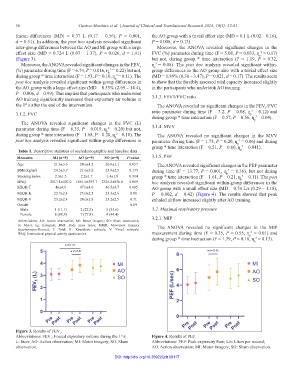
        (mean  differences  [MD]  =  0.37  L  (0.17  –  0.56),  P  =  0.001,   the AO group with a trivial effect size (MD = 0.1 L (0.02 – 0.16),
        d = 0.51). In addition, the post hoc analysis revealed significant   P = 0.008, d = 0.13).
        inter-group differences between the AO and MI group with a large   Moreover,  the  ANOVA  revealed  significant  changes  in  the
        effect size (MD = 0.724 L (0.07 – 1.37), P = 0.026, d = 1.41)   FVC (%) parameter during time (F = 5.08, P = 0.033, ƞ  = 0.17)
                                                                                                              2
                                                                                                             p
        (Figure 3).                                             but  not, during  group * time  interaction  (F = 1.19,  P  =  0.32,
          Moreover, the ANOVA revealed significant changes in the FEV    ƞ =  0.08).  The  post  hoc  analysis  revealed  significant  within-
                                                                  2
                                                                 p
                                                           1
        (%) parameter during time (F = 6.74, P = 0.016, ƞ  = 0.22) but not,   group differences in the AO group also with a trivial effect size
                                               2
                                              p
        during group * time interaction (F = 1.93, P = 0.16, ƞ = 0.11). The   (MD = 1.89% (0.30 – 3.47), P = 0.021, d = 0.17). The results seem
                                                  2
                                                 p
        post hoc analysis revealed significant within-group differences in   to show that the forcibly assessed vital capacity increased slightly
        the AO group with a large effect size (MD = 8.55% (2.69 – 14.4),   in the participants who undertook AO training.
        P = 0.006, d = 0.99). This implies that participants who underwent
        AO training significantly increased their expiratory air volume in   3.1.3. FEV1/FVC ratio
        the 1  s after the end of the intervention.                The ANOVA revealed no significant changes in the FEV /FVC
            st
                                                                                                                1
                                                                                                          2
        3.1.2. FVC                                              ratio parameter during time (F = 3.2, P = 0.08, ƞ = 0.12) and
                                                                                                          p
                                                                during group * time interaction (F = 0.57, P = 0.56, ƞ = 0.04).
                                                                                                            2
                                                                                                           p
          The  ANOVA  revealed  significant  changes  in  the  FVC  (L)
        parameter during time (F = 6.35, P = 0.019, ƞ = 0.20) but not,   3.1.4. MVV
                                              2
                                              p
        during group * time interaction (F = 1.68, P = 0.20, ƞ = 0.10). The   The  ANOVA  revealed  no  significant  changes  in  the  MVV
                                                  2
                                                 p
        post hoc analysis revealed significant within-group differences in   parameter during time (F = 1.73, P = 0.20, ƞ  = 0.06) and during
                                                                                                     2
                                                                                                    p
                                                                group * time interaction (F = 0.51, P = 0.60, ƞ  = 0.041).
                                                                                                      2
         Table 1. Descriptive statistics of sociodemographic and baseline data                       p
        Measures       MI (n=9)   AO (n=9)   SO (n=9)  P‑value  3.1.5. PEF
        Age             21.6±3.6  24.6±4.2   20.9±1.1  0.057       The ANOVA revealed significant changes in the PEF parameter
        BMI (kg/m )     24.5±3.7  21.6±3.8   23.9±2.5  0.173    during time (F = 13.77, P = 0.001, ƞ  = 0.36), but not during
                2
                                                                                                2
                                                                                                p
        Smoking index   2.3±1.5    2.2±1.7    1.4±1.0  0.314    group * time interaction (F = 1.61, P = 0.21, ƞ  = 0.11). The post
                                                                                                      2
                                                                                                     p
        IPAQ          2517.1±407.0  1861.6±397.7  2326.5±836.8  0.069  hoc analysis revealed significant within-group differences in the
        MIQR-T          46±4.6    47.0±4.0   46.5±4.7  0.895    AO group with a small effect size (MD = 0.74 L/s (0.29 – 1.18),
        MIQR-K          22.7±2.4  23.0±2.5   23.3±2.6  0.88     P = 0.002, d = 0.42) (Figure 4). The results showed that peak
        MIQR-V          23.2±2.4  24.0±1.8   23.2±2.5  0.71     exhaled airflow increased slightly after AO training.
        Gender                                         0.09
          Male          1 (11.1)   2 (22.2)  5 (55.6)           3.2. Maximal respiratory pressure
          Female        8 (88.9)   7 (77.8)  4 (44.4)
         Abbreviations:  AO:  Action observation; MI: Motor imagery;  SO: Sham observation;   3.2.1. MIP
         m:  Meter;  kg:  Kilogram;  BMI:  Body  mass  index;  MIQR:  Movement  Imagery   The  ANOVA  revealed  no  significant  changes  in  the  MIP
         Questionnaire-Revised;  T:  Total;  K:  Kinesthetic  subscale;  V:  Visual  subscale;
                                                                                                          2
         IPAQ: International physical activity questionnaire.   measurement during time (F = 0.35, P = 0.55, ƞ  = 0.01) and
                                                                                                         p
                                                                during group * time interaction (F = 1.79, P = 0.18, ƞ  = 0.13).
                                                                                                            2
                                                                                                           p


        Figure 3. Results of FEV .
                          1
        Abbreviations: FEV : Forced expiratory volume during the 1  s;   Figure 4. Results of PEF.
                                                   st
                      1
        L: liters; AO: Action observation; MI: Motor imagery; SO: Sham   Abbreviations: PEF: Peak expiratory flow; L/s: Liters per second;
        observation.                                            AO: Action observation; MI: Motor imagery; SO: Sham observation.
                                                 DOI: http://doi.org/10.36922/jctr.00117

