


Page 59 - JCTR-10-1
P. 59
Cuenca-Martínez et al. | Journal of Clinical and Translational Research 2024; 10(1): 52-61   55
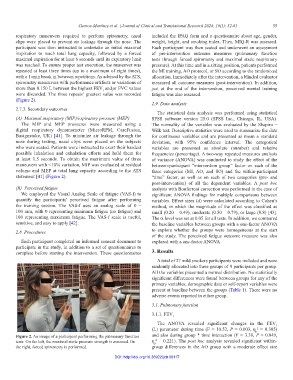
        respiratory  maneuvers  required  to perform  spirometry, nasal   included the IPAQ form and a questionnaire about age, gender,
        clips were placed to prevent air leakage through the nose. The   weight, height, and smoking index. Then, MIQ-R was assessed.
        participant was then instructed  to undertake  an initial  maximal   Each participant was then seated and underwent an assessment
        inspiration  to reach total  lung capacity, followed by a forced   of pre-intervention  outcome  measures  (pulmonary  function
        maximal expiration for at least 6 seconds until its expiratory limit   tests through forced spirometry and maximal  static respiratory
        was reached. To ensure proper test execution, the maneuver was   pressure). At this time and in a sitting position, patients performed
        repeated at least three times (up to a maximum of eight times),   the MI training, AO protocol, or SO according to the randomized
        with a 1-min break in between repetitions. As advised by the ATS,   allocation. Immediately after the intervention, a blinded evaluator
        spirometry maneuvers with performance artifacts or variations of   measured all outcome measures (post-intervention). In addition,
        more than 0.150 L between the highest FEV and or FVC values   just  at  the  end  of  the  intervention,  perceived  mental  training
                                            1
                                                /
        were discarded. The  three  repeats’ greatest  value  was recorded   fatigue was also assessed.
        (Figure 2).
                                                                2.9. Data analysis
        2.7.3. Secondary outcomes
                                                                   The  statistical  data  analysis  was performed  using statistical
        (A)  Maximal inspiratory (MIP)/expiratory pressure (MEP)  SPSS  software  version  25.0  (SPSS  Inc.,  Chicago,  IL,  USA).
          The  MIP  and  MEP  pressures  were  measured  using  a   The normality of the variables was evaluated by the Shapiro –
        digital  respiratory  dynamometer  (MicroRPM,  CareFusion,   Wilk test. Descriptive statistics were used to summarize the data
        Basignstoke,  UK)  [41].  To minimize air leakage through the   for continuous  variables  and  are  presented  as mean  ±  standard
        nose during testing, nasal clips were placed on the subjects   deviation,  with  95%  confidence  interval.  The  categorical
        who were seated. Patients were instructed to exert their hardest   variables are presented as absolute (number) and relative
        possible  inhalation  and  exhalation  efforts  and  hold  them  for   frequencies (percentage). A two-way repeated measures analysis
        at  least  1.5  seconds.  To  obtain  the  maximum  value  of  three   of variance (ANOVA) was conducted to study the effect of the
        maneuvers with <10% variation, MIP was evaluated at residual   between-participant  “intervention group” factor  on each of the
        volume and MEP at total lung capacity according to the ATS   three categories  (MI,  AO,  and SO)  and the within-participant
        statement [41] (Figure 2).                              “time”  factor, as well  as on each  of two categories  (pre-  and
                                                                post-intervention)  of all the dependent variables.  A  post hoc
        (B)  Perceived fatigue                                  analysis with Bonferroni correction was performed in the case of
          We employed the Visual Analog Scale of fatigue (VAS-f) to   significant ANOVA  findings  for  multiple  comparisons  between
        quantify  the  participants’ perceived  fatigue  after  performing   variables. Effect sizes (d) were calculated according to Cohen’s
        the  training  session.  The  VAS-f  uses  an  analog  scale  of  0  –   method, in which the magnitude of the effect was classified as
        100 mm, with 0 representing minimum fatigue (no fatigue) and   small (0.20 – 0.49), moderate (0.50 – 0.79), or large (0.8) [43].
        100  representing  maximum  fatigue. The VAS-f  scale  is  useful,   The α level was set at 0.05 for all tests. In addition, we compared
        sensitive, and easy to apply [42].                      the baseline variables between groups with a one-factor ANOVA

        2.8. Procedures                                         to explore whether the groups were homogeneous at the start
                                                                of the study. The perceived  fatigue  outcome  measure  was also
          Each participant completed an informed consent document to   explored with a one-factor ANOVA.
        participate in the study, in addition to a set of questionnaires to
        complete  before starting  the intervention.  These questionnaires   3. Results
                                                                   A total of 27 mild smokers participants were included and were
                                                                randomly allocated into three groups of 9 participants per group.
                                                                All the variables presented a normal distribution. No statistically
                                                                significant differences were found between groups for any of the
                                                                primary variables, demographic data or self-report variables were
                                                                present at baseline between the groups (Table 1). There were no
                                                                adverse events reported in either group.

                                                                3.1. Pulmonary function
                                                                3.1.1. FEV 1
                                                                   The  ANOVA  revealed  significant  changes  in  the  FEV
                                                                                                                    1
                                                                (L) parameter during time (F = 10.52, P = 0.003, ƞ  = 0.305)
                                                                                                            2
                                                                                                            p
        Figure 2. An image of a participant performing the pulmonary function   and also during group * time interaction (F = 3.39, P = 0.049,
                                                                  2
        tests. On the left, the maximal static pressure strength is assessed. On   ƞ  = 0.221). The post hoc analysis revealed significant within-
                                                                 p
        the right, forced spirometry is performed.              group  differences  in  the AO  group  with  a  moderate  effect  size
                                                 DOI: http://doi.org/10.36922/jctr.00117

