


Page 61 - JCTR-10-1
P. 61
Cuenca-Martínez et al. | Journal of Clinical and Translational Research 2024; 10(1): 52-61   57
        3.2.2. MEP

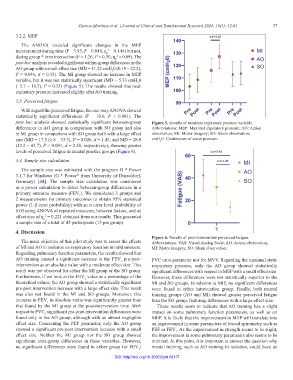
          The  ANOVA  revealed  significant  changes  in  the  MEP
        measurement during time (F = 3.95, P = 0.048, ƞ  = 0.144) but not,
                                              2
                                             p
        during group * time interaction (F = 1.26, P = 0.30, ƞ  = 0.09). The
                                                  2
                                                 p
        post hoc analysis revealed significant within-group differences in the
        AO group with a small effect size (MD = 11.22 cmH 0 (0.19 – 22.2),
                                                2
        P = 0.046, d = 0.33). The MI group showed an increase in MEP
        variable, but it was not statistically significant (MD = 5.33 cmH 0
                                                          2
        (−5.7 – 16.3), P = 0.33) (Figure 5). The results showed that peak
        expiratory pressure increased slightly after AO training.
        3.3. Perceived fatigue
          With regard the perceived fatigue, the one-way ANOVA showed
        statistically  significant  differences  (F  =  10.6,  P  <  0.001).  The
        post hoc analysis showed statistically significant between-group   Figure 5. Results of maximal expiratory pressure variable.
        differences in AO group in comparison with SO group and also   Abbreviations: MEP: Maximal expiratory pressure; AO: Action
        in MI group in comparison with SO group both with a large effect   observation; MI: Motor imagery; SO: Sham observation;
        size (MD = 17.5 (1.8 – 33.3), P = 0.026, d = 1.45, and MD = 28.0   cmH 0: Centimeters of water pressure.
                                                                    2
        (12.2 – 43.7), P < 0.001, d = 2.58, respectively), showing greater
        levels of perceived fatigue in mental practice groups (Figure 6).
        3.4. Sample size calculation
          The sample size was estimated with the program G * Power
        3.1.7 for Windows (G * Power  from University of Dusseldorf,
                                 ©
        Germany) [44].  The sample size calculation  was considered
        as a power calculation to detect between-group differences in a
        primary outcome measure (FEV ). We considered 3 groups and
                                  1
        2 measurements for primary outcomes to obtain 95% statistical
        power (1-β error probability) with an α error level probability of
        0.05 using ANOVA of repeated measures, between factors, and an
        effect size of   = 0.221 obtained from our results. This generated
                    2

        a sample size of a total of 45 participants (15 per group).
        4. Discussion
                                                                Figure 6. Results of post-intervention perceived fatigue.
          The main objective of this pilot study was to assess the effects   Abbreviations: VAS: Visual Analog Scale; AO: Action observation;
        of MI and AO in isolation on respiratory function in mild smokers.   MI: Motor imagery; SO: Sham observation.
        Regarding pulmonary function parameters, the results showed that
        AO training caused a significant increase in the FEV  pre-post-  FVC ratio parameter nor for MVV. Regarding the maximal static
                                                   1
        intervention as an absolute value with a moderate effect size. This   respiratory  pressure, only the  AO group showed statistically
        result was not observed for either the MI group or the SO group.   significant differences with respect to MEP with a small effect size.
        Furthermore, if we look at the FEV  value as a percentage of the   However, these differences were not statistically superior to the
                                    1
        theoretical values, the AO group showed a statistically significant   MI and SO groups. In relation to MIP, no significant differences
        pre-post intervention increase with a large effect size. This result   were found in either  intervention  group. Finally, both mental
        was also not found in the MI and SO  groups. Moreover, this   training groups (AO and MI) showed greater perceived fatigue
        increase in FEV  in absolute value was significantly greater than   than the SO group, featuring differences with a large effect size.
                     1
        that found by the MI group at the post-intervention time. With   These results seem to indicate  that AO training  has a slight
        respect to FVC, significant pre-post-intervention differences were   impact  on some pulmonary  function  parameters,  as well  as on
        found only in the AO group, although with an almost negligible   MEP. It is likely that the improvement in MEP will translate into
        effect  size.  Concerning  the  PEF  parameter,  only  the AO  group   an improvement in some parameters of forced spirometry such as
        showed a significant pre-post-intervention increase with a small   PEF or FEV . As the improvement in strength seems to be slight,
                                                                          1
        effect  size.  Neither  the  MI  group  nor  the  SO  group  showed   the improvement in some pulmonary parameters also seems to be
        significant  intra-group  differences  in  these  variables.  However,   minimal. At this point, it is important to answer the question why
        no significant differences were found in either group for FEV /  mental training, such as AO training in isolation, could have an
                                                           1
                                                 DOI: http://doi.org/10.36922/jctr.00117

