


Page 27 - JCTR-10-2
P. 27
Abtahi et al. | Journal of Clinical and Translational Research 2024; 10(2): 119-140   121
        of possible outcomes for each patient were defined based on the   2.3. Expert consensus and questionnaire-based survey
        clinicians’ views and agreement. The six potential areas of decision-
        making were considered through expert consultation to classify the   Expert consensus refers to the collective opinions of clinical
        influential  factors  extracted  from  the  reviewed  publications. The   experts on a clinical topic and it is employed to provide quantitative
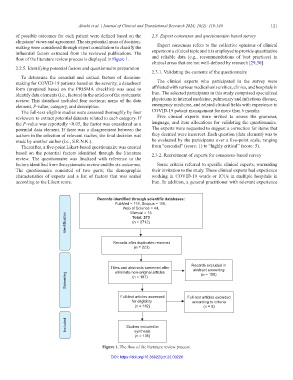
        flow of the literature review process is displayed in Figure 1.  and  reliable  data  (e.g.,  recommendations  of  best  practices)  in
                                                                clinical areas that are not well-defined by research [29,30].
        2.2.5. Identifying potential factors and questionnaire preparation
                                                                2.3.1. Validating the contents of the questionnaire
          To determine the essential and critical  factors of decision-
        making for COVID-19 patients based on the severity, a datasheet/  The  clinical  experts who participated  in the  survey were
        form  (prepared  based  on  the  PRISMA  checklist)  was  used  to   affiliated with various medical universities, clinics, and hospitals in
        identify data elements (i.e., factors) in the articles of the systematic   Iran. The selected participants in this study comprised specialized
        review. This datasheet included four sections; name of the data   physicians in internal medicine, pulmonary and infectious disease,
        element, P-value, category, and description.            emergency medicine, and related clinical fields with experience in
          The full-text eligible studies were assessed thoroughly by four   COVID-19 patient management for more than 6 months.
        reviewers to extract potential datasets related to each category. If   Five  clinical  experts  were  invited  to  assess  the  grammar,
        the P-value was reportedly <0.05, the factor was considered as a   language, and item allocations for validating the questionnaire.
        potential data element. If there was a disagreement between the   The experts were requested to suggest a correction for items that
        authors in the selection of relevant studies, the final decision was   they deemed were incorrect. Each question (data element) was to
        made by another author (i.e., S.R.N.K.).                be evaluated by the participants over a five-point scale, ranging
          Thereafter, a five-point Likert-based questionnaire was created   from “essential” (score: 1) to “highly critical” (score: 5).
        based  on  the  potential  factors  identified  through  the  literature   2.3.2. Recruitment of experts for consensus-based survey
        review.  The  questionnaire  was  finalized  with  reference  to  the
        factors identified from the systematic review and the six outcomes.   Some criteria referred to specific clinical experts, warranting
        The  questionnaire  consisted  of two  parts;  the  demographic   their invitation to the study. These clinical experts had experience
        characteristics  of experts and a list of factors that was scaled   working in  COVID-19 wards or ICUs in  multiple  hospitals  in
        according to the Likert score.                          Iran. In addition, a general practitioner with relevant experience


                                          Records identified through scientific databases:
                                                 PubMed = 118, Scopus = 116,
                                                    Web of Science = 44,
                                                        Manual = 15
                             Identification             Total: 273
                                                        (n = 2712)


                                                Records after duplicates removed
                                                         (n = 223)


                                                                                 Records excluded in
                                               Titles and abstracts screened after  abstract screening
                                                 eliminate non-original articles
                             Screening                  (n = 187)                    (n = 150)


                                                   Full-text articles assessed  Full-text articles excluded
                                                        for eligibility          according to criteria
                                                         (n = 142)                    (n = 9)


                             Included                 Studies included in

                                                         synthesis
                                                         (n = 136)

                                            Figure 1. The flow of the literature review process.
                                                DOI: https://doi.org/10.36922/jctr.22.00226

