


Page 29 - JCTR-10-2
P. 29
Abtahi et al. | Journal of Clinical and Translational Research 2024; 10(2): 119-140   123
          In  the  second  step,  the  factors  were  validated  concerning   Table 1.  General  characteristics  (i.e.,  type  of  clinical  decision  and
        each outcome via CVI calculation, and the critical factors were   country) of the evaluated articles
        determined.                                              Characteristic                     Number of articles
                                                                                                 (relative to all articles [%])
        3.1. Literature review to identify the effective factors  Type of clinical decision
          Overall, 273 articles were obtained from the literature search.   Length of stay              12 (8.89)
        Fifty duplicate studies were removed accordingly. After assessing   Ward referrals              9 (6.67)
        the  title,  abstract,  and  full  text  of  the  articles  and  excluding   Home referrals     4 (2.96)
        the  irrelevant  studies,  the  remaining  136  articles  were  further   Deterioration        98 (72.59)
        evaluated. The articles were evaluated for the relevant factors (e.g.,   Discharge             15 (11.11)
        effective  factors  and  clinical  tests  in  COVID-19  management)   ICU referrals            30 (22.22)
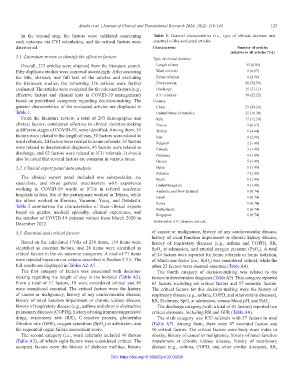
        based on predefined categories regarding decision-making. The   Country
        general characteristics of the evaluated articles are displayed in   China                     53 (39.26)
        Table 1.                                                  United States of America             22 (16.30)
          From  the  literature  review,  a  total  of  293  demographic  and   Italy                  17 (12.59)
        clinical factors, considered effective in clinical decision-making   France                     9 (6.67)
        at different stages of COVID-19, were identified. Among them, 51   Turkey                       6 (4.44)
        factors were related to the length of stay, 50 factors were related to   Iran                   4 (2.96)
        ward referrals, 24 factors were related to home referrals, 63 factors   Belgium                 2 (1.48)
        were related to deterioration diagnosis, 43 factors were related to   Canada                    3 (1.48)
        discharge, and 62 factors were related to ICU referrals. It should   Germany                    4 (1.48)
        also be noted that several factors are common in various areas.
                                                                  Greece                                5 (1.48)
        3.2. Clinical expert panel data analysis                  Japan                                 6 (1.48)
                                                                  Pakistan                              7 (1.48)
          The  clinical  expert  panel  included  one  subspecialist,  six   Spain                      8 (1.48)
        specialists,  and  three  general  practitioners  with  experience   United Kingdom             9 (1.48)
        working in COVID-19  wards or ICUs  in referral academic   Australia and New Zealand            1 (0.74)
        hospitals in Iran. Six of the participants worked in Tehran, while   Israel                     1 (0.74)
        the  others  worked  in  Kerman,  Varamin,  Yasuj,  and  Dehdasht.   Korea                      1 (0.74)
        Table 2 summarizes the characteristics of these clinical experts
        based  on  gender,  medical  specialty,  clinical  experience,  and   Netherlands               1 (0.74)
                                                                  Singapore
                                                                                                        1 (0.74)
        the number of COVID-19 patients visited from March 2020 to
        December 2022.                                           Abbreviation: ICU: Intensive care unit.
        3.3. Essential and critical factors                     of cancer or malignancy, history of any cardiovascular disease,
                                                                history of renal function impairment or chronic kidney disease,
          Based on the calculated CVRs of 258 items, 159 items were   history  of  respiratory  diseases  (e.g.,  asthma  and  COPD),  RR,
        identified  as  essential  factors,  and  28  items  were  identified  as   SpO  at admission, and arterial oxygen pressure (PaO ). A total
                                                                                                             2
                                                                    2
        critical factors in the six outcome categories. A total of 71 items   of 24 factors were reported for home referrals or home isolation,
        were rejected based on our criteria described in Section 2.3.5. The   of which one factor (i.e., SpO ) was considered critical, while the
                                                                                        2
        full results are displayed in Tables A2-A7.             other 23 factors were deemed essential (Table A4).
          The  first  category  of  factors  was  associated  with  decision-  The  fourth  category  of  decision-making  was  related  to the
        making regarding the length of stay in the hospital (Table A2).   factors in deterioration diagnosis (Table A5). This category reported
        From  a  total  of  51  factors,  10  were  considered  critical  and  41   63 factors, including six critical factors and 57 essential factors.
        were considered essential. The critical  factors were the history   The critical factors for this decision-making were the history of
        of cancer or malignancy, history of any cardiovascular disease,   respiratory disease (e.g., asthma, COPD, and other similar diseases),
        history of renal function impairment or chronic kidney disease,   RR, D-dimers, SpO  at admission, venous blood pH, and PaO .
                                                                                                                 2
                                                                                2
        history of respiratory disease (e.g., asthma and chronic obstructive   The discharge category (with a total of 43 factors) reported two
        pulmonary diseases [COPD]), history of using immunosuppressive   critical elements, including RR and GFR (Table A6).
        drugs,  respiratory  rate  (RR),  C-reactive  protein,  glomerular   The sixth category was ICU referrals with 57 factors in total
        filtration rate (GFR), oxygen saturation (SpO ) at admission, and   (Table  A7).  Among  them,  there  were  47  essential  factors  and
                                            2
        the sequential organ failure assessment score.          10 critical factors. The critical factors were body mass index or
          The second category (i.e., ward referrals) included 49 factors   obesity, history of cancer or malignancy, history of renal function
        (Table A3), of which eight factors were considered critical. The   impairment  or  chronic  kidney  disease,  history  of  respiratory
        accepted  factors  were  the  history  of  diabetes  mellitus,  history   disease  (e.g.,  asthma,  COPD,  and  other  similar  diseases),  RR,
                                                DOI: https://doi.org/10.36922/jctr.22.00226

