


Page 28 - JCTR-10-2
P. 28
122                       Abtahi et al. | Journal of Clinical and Translational Research 2024; 10(2): 119-140
        and  interest  in  the  study  would be  invited  to  participate  in  the   (i.e., 0.62) were considered “essential,” implying an agreement
        study as well. With reference to the Lawshe table [31], the number   from more than half of the clinical experts on the particular item.
        of participants was limited to 10 clinical experts for an optimal   A sub-zero CVR would indicate that less than half of the clinical
        content validity ratio (CVR) during expert agreement analysis.  experts  considered  an  item  “essential,”  and  the  item  would
                                                                subsequently be rejected [33,34]. All of the results were analyzed
        2.3.3. Conducting the questionnaire-based survey        using IBM statistical package for the social sciences v20.
          We  conducted  the  questionnaire-based  survey  by  initially   3. Results
        sharing an online link to the questionnaire with the clinical experts
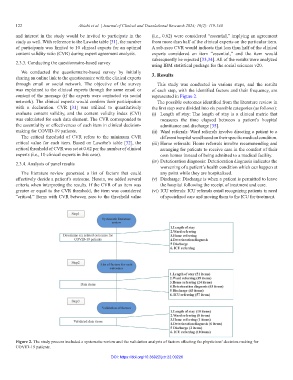
        through  email  or  social  network.  The  objective  of  the  survey   This  study  was  conducted  in  various  steps,  and  the  results
        was explained to the clinical experts through the same email or   of each step, with the identified factors and their frequency, are
        content of the message (if the experts were contacted via social   represented in Figure 2.
        network). The clinical experts would confirm their participation   The possible outcomes identified from the literature review in
        with  a declaration.  CVR [31]  was  utilized  to  quantitatively   the first step were divided into six possible categories (as follows):
        evaluate  content  validity,  and  the  content  validity  index  (CVI)   (i)  Length of stay: The length of stay is a clinical metric that
        was calculated for each data element. The CVR corresponded to   measures  the  time  elapsed  between  a  patient’s hospital
        the essentiality or effectiveness of each item in clinical decision-  admittance and discharge [35].
        making for COVID-19 patients.                           (ii)  Ward referrals: Ward referrals involve directing a patient to a
          The  critical  threshold  of CVR refers to the  minimum  CVR   different hospital ward based on their specific medical condition.
        critical value for each item. Based on Lawshe’s table [32], the   (iii) Home referrals: Home referrals involve recommending and
        critical threshold of CVR was set at 0.62 per the number of clinical   arranging for patients to receive care in the comfort of their
        experts (i.e., 10 clinical experts in this case).           own homes instead of being admitted to a medical facility.

        2.3.4. Analysis of panel results                        (iv) Deterioration diagnosis: Deterioration diagnosis indicates the
                                                                    worsening of a patient’s health condition which can happen at
          The  literature  review  generated a list  of factors  that  could   any point while they are hospitalized.
        effectively decide a patient’s outcome. Herein, we added several   (v)  Discharge: Discharge is when a patient is permitted to leave
        criteria when interpreting the results. If the CVR of an item was   the hospital following the receipt of treatment and care.
        greater or equal to the CVR threshold, the item was considered   (vi) ICU referrals: ICU referrals entail recognizing patients in need
        “critical.” Items with CVR between zero to the threshold value   of specialized care and moving them to the ICU for treatment.


        Figure 2. The study process included a systematic review and the validation analysis of factors affecting the physicians’ decision-making for
        COVID-19 patients.
                                                DOI: https://doi.org/10.36922/jctr.22.00226

