


Page 31 - JCTR-10-2
P. 31
Abtahi et al. | Journal of Clinical and Translational Research 2024; 10(2): 119-140   125
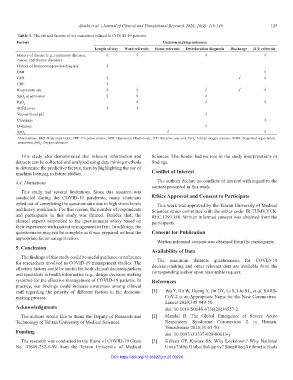
        Table 3. The critical factors of six outcomes related to COVID-19 patients
        Factors                                                      Decision‑making outcomes
                                         Length of stay  Ward referrals  Home referrals  Deterioration diagnosis  Discharge  ICU referrals
        History of disease (e.g., respiratory diseases,    √  √                       √                        √
        cancer, and chronic diseases)
        History of immunosuppressive drug use  √
        BMI                                                                                                    √
        GFR                                  √                                                      √          √
        CRP                                  √
        Respiratory rate                     √            √                           √             √          √
        SpO  at admission                    √            √                           √
           2
        PaO                                               √                           √                        √
           2
        SOFA score                           √            √
        Venous blood pH                                                               √
        Creatinine                                                                                             √
        D-dimers                                                                      √
        SpO                                                            √                                       √
           2
        Abbreviations: BMI: Body mass index; CRP: C-reactive protein; GFR: Glomerular filtration rate; ICU: Intensive care unit; PaO : Arterial oxygen pressure; SOFA: Sequential organ failure
                                                                                  2
        assessment; SpO : Oxygen saturation.
                  2
          This  study also demonstrated  that  relevant  information  and   Sciences. The funder had no role in the study interpretations or
        datasets can be collected and analyzed using data mining methods   findings.
        to determine the predictive factors, thereby highlighting the use of
        machine learning in future studies.                     Conflict of Interest

        4.4. Limitations                                           The authors declare no conflicts of interest with regard to the
                                                                content presented in this work.
          This  study  had  several  limitations.  Since  this  research  was
        conducted  during  the  COVID-19  pandemic,  many  clinicians   Ethics Approval and Consent to Participate
        opted out of completing the questionnaire due to high stress levels   This work was approved by the Tehran University of Medical
        and heavy workloads. For this reason, the number of respondents   Sciences ethics committee with the ethics code: IR.TUMS.VCR.
        and  participants  in  this  study  was  limited.  Besides  that,  the   REC.1399.188. Written informed consent was obtained from the
        clinical experts responded to the questionnaire  solely based on   participants.
        their experience with patient management in Iran. In addition, the
        questionnaire may not be complete as it was prepared without the   Consent for Publication
        appropriate factor categorization.
                                                                   Written informed consent was obtained from the participants.
        5. Conclusion
                                                                Availability of Data
          The findings of this study could be useful guidance or reference
        for researchers involved in COVID-19 management studies. The   The  minimum datasets  questionnaire  for COVID-19
        effective factors could be useful for both clinical decision-makers   decision-making and other relevant data are available from the
        and specialists in health informatics (e.g., design decision-making   corresponding author upon reasonable request.
        systems) for the effective management of COVID-19 patients. In   References
        practice,  our  findings  could  increase  awareness  among  clinical
        staff  regarding  the  priority  of  different  factors  in  the  decision-  [1]   Wu Y, Ho W, Huang Y, Jin DY, Li S, Liu SL, et al. SARS-
        making process.                                               CoV-2 is an Appropriate Name for the New Coronavirus.
                                                                      Lancet 2020;395:949-50.
        Acknowledgments                                               doi: 10.1016/S0140-6736(20)30557-2

          The authors would like to thank the Deputy of Research and   [2]   Mandal  B.  The  Global  Emergence  of  Severe  Acute
        Technology of Tehran University of Medical Sciences.          Respiratory  Syndrome  Coronavirus  2  in  Human.
                                                                      Virusdisease 2020;31:67-70.
        Funding                                                       doi: 10.1007/s13337-020-00613-y

          The research was conducted in the frame of COVID-19 Grant   [3]   Killeen GF, Kiware SS. Why Lockdown? Why National
        No.  47609-252-1-99  from  the  Tehran  University  of  Medical   Unity? Why Global Solidarity? Simplified Arithmetic Tools
                                                DOI: https://doi.org/10.36922/jctr.22.00226

