


Page 60 - JCTR-10-2
P. 60
154                       Koschny et al. | Journal of Clinical and Translational Research 2024; 10(2): 151-158

                          A


                          B


                          C


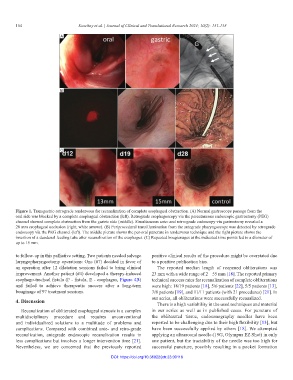
        Figure 1. Transgastric-retrograde rendezvous for recanalization of complete esophageal obstruction. (A) Normal gastroscope passage from the
        oral side was blocked by a complete esophageal obstruction (left). Retrograde esophagoscopy via the percutaneous endoscopic gastrostomy (PEG)
        channel showed complete obstruction from the gastric side (middle). Simultaneous ante- and retro-grade endoscopy via gastrostomy revealed a
        20 mm esophageal occlusion (right, white arrows). (B) Periprocedural transillumination from the antegrade pharyngoscope was detected by retrograde
        endoscopy via the PEG channel (left). The middle picture shows the per-oral puncture in rendezvous technique and the right picture shows the
        insertion of a duodenal feeding tube after recanalization of the esophagus. (C) Repeated bougienages at the indicated time points led to a diameter of
        up to 15 mm.


        to follow-up in this palliative setting. Two patients needed salvage   positive clinical results of the procedure might be overstated due
        laryngopharyngectomy operations: One (#7) decided in favor of   to a positive publication bias.
        an operation after 12 dilatation sessions failed to bring clinical   The  reported  median  length  of  reopened  obliterations  was
        improvement. Another patient (#4) developed a therapy-induced   23 mm with a wide range of 2 – 55 mm [18]. The reported primary
        esophago-tracheal fistula (F - fistula, E - esophagus, Figure 4B)   technical success rates for recanalization of complete obliterations
        and  failed  to  achieve  therapeutic  success after  a  long-term   were high: 18/19 patients [18], 5/6 patients [22], 5/5 patients [13],
        bouginage of 97 treatment sessions.                     7/8 patients [19], and 11/11 patients (with 21 procedures) [21]. In
                                                                our series, all obliterations were successfully recanalized.
        4. Discussion
                                                                   There is a high variability in the used techniques and material
          Recanalization of obliterated esophageal stenosis is a complex   in our series as well as in published cases. For puncture of
        multidisciplinary  procedure and requires unconventional   the obliterated tissue, endosonography needles have been
        and individualized  solutions to a multitude  of problems and   reported to be challenging due to their high flexibility [13], but
        complications.  Compared with combined ante-  and retro-grade   have been successfully applied by others [18]. We attempted
        recanalization,  antegrade endoscopic recanalization  results in   applying an ultrasound needle (19G, Olympus EZ Shot) in only
        less complications but involves a longer intervention time [21].   one patient, but the tractability of the needle was too high for
        Nevertheless,  we are  concerned  that  the  previously  reported   successful puncture, possibly resulting in a pocket formation
                                                DOI: https://doi.org/10.36922/jctr.23.00116

