


Page 68 - JCTR-10-2
P. 68
162                       Wang et al. | Journal of Clinical and Translational Research 2024; 10(2): 159-164
        lower than the control group (t = 9.8287; 95% CI: (2.4551, 2.8116);   therapy  modality  that  combines  the  meridian  theory  from
        P < 0.001). Similarly, the GAD-7 scores of the experimental group   traditional Chinese medicine with modern bioelectronic principles
        were also significantly lower than the control (t = 7.8190; 95%   derived  from  acupuncture  therapy.  This  technique  leverages
        CI: (3.4477, 3.7689); P < 0.001) (Table 3).             electrical  stimulation  to  promote  blood  circulation,  alleviate  qi
                                                                and  blood  stagnation,  and  ultimately  reduce  pain  [17]. Certain
        3.5. Side effects                                       studies  have  reported  that  appropriate,  low-frequency  pulsed

          During  the  study,  two  patients  in  the  control  group  (6.90%)   current  may  activate  endogenous  morphine-like  polymorphic
        and one patient in the experimental group (3.45%) experienced   neurons in the brain, thereby providing analgesic efficacy, while
        mild nausea and vomiting. The nausea and vomiting disappeared   eliminating  pain-causing chemical  mediators  and reducing  the
        after a few days without any therapy. After further evaluation, it   chemical factors of pain [18]. In addition, low-frequency pulse
        was concluded that nausea and vomiting were caused by the use of   therapy may enhance microcirculation in the body, facilitate nerve
        valaciclovir, as these are common adverse reactions of valaciclovir.   repair, excite neuromuscular tissues, improve nutrition, expedite
        Nonetheless, none of the patients withdrew from the study because   the absorption and dissipation of inflammatory substances, and
        of the nausea and vomiting. There were no other adverse effects   alleviate pain from diverse causes [19]. However, low-frequency
        reported during the follow-up period, and the patients did not   pulse therapy has not been specifically applied for the treatment of
        experience any discomfort or symptoms due to the use of therapeutic   herpes zoster-associated pain.
        drugs or the pulse microcurrent electrical neuromuscular stimulator.  Pulsed microcurrent stimulation involves the application
                                                                of  microcurrent  to  acupoints,  employing  specific  frequencies,
        4. Discussion                                           intensities, and waveforms of electric current in accordance with

          Herpes zoster is a viral ailment associated with high morbidity,   therapeutic  needs  [20].  This technique harnesses the electrical
        and its clinical symptoms primarily manifest as severe pain and   responses of nerves and muscles to low and moderate frequencies,
        herpes  lesions.  These  symptoms  may  predispose  patients  to   delivering  gentle  electric  currents  across  the  skin  surface.
        varying degrees of anxiety and depression, ultimately affecting   Furthermore, the use of electrodes stimulates targeted acupoints
        their quality of life. Contemporary research implicated neuralgia   and exerts its therapeutic influence on the treated area, suggesting
        as the primary cause of the severe pain caused by herpes zoster,   its prospective application for specific medical conditions [21].
        primarily associated with central nerve abnormality and peripheral   The pulse microcurrent electrical  neuromuscular  stimulator
        neuropathy induced by viral neuropathic invasion. Therefore, the   utilized in this study had adjustable intensity settings for both mid-
        treatment of herpes zoster focuses on antiviral therapy, neurotrophic   frequency (1 – 30 kHz) and low-frequency (1 – 120 Hz) ranges.
        support,  anti-infective  measures,  and  pain  management  [3].   As frequency and intensity correspond to each other, adjusting the
        In  this  study,  the  control  group  received  conventional  drugs   intensity settings could align the frequency for specific therapeutic
        recommended by the guidelines for the diagnosis and treatment   requirements, producing the combined effects of mid-frequency
        of herpes zoster, while the experimental group received treatment   and low-frequency pulsation therapy. Our findings demonstrated
        with a pulse microcurrent electrical neuromuscular stimulator in   that, following a 14-day treatment period, the experimental group
        conjunction with conventional drugs. Pulse therapy is a physical   exhibited a shorter infection duration than the control group. In
                                                                addition, the experimental group displayed significantly greater
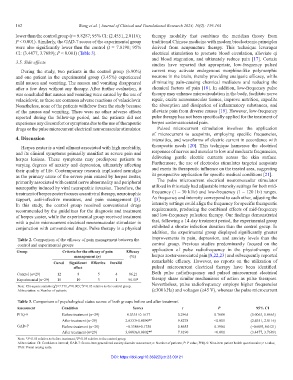
        Table 2. Comparison of the efficacy of pain management between the   improvements  in  pain,  depression,  and  anxiety  levels  than  the
        control and experimental groups                         control  group.  Previous  studies  predominantly  focused  on  the
        Group              Criteria for the efficacy of pain   Efficacy   application  of  pulse  radiofrequency  in  the  physiotherapy  of
                                management (n)         (%)      herpes zoster-associated pain [8,22,23] and subsequently reported
                       Cured  Significant  Effective  Invalid   remarkable  efficacy.  However,  no  reports  on  the  utilization  of
                                effect                          pulsed  microcurrent  electrical  therapy  have  been  identified.
        Control (n=29)   12      8        5      4     86.21    Both  pulse  radiofrequency  and  pulsed  microcurrent  electrical
        Experimental (n=29)  15  10       3      1     96.55 #  therapy  share  similar  mechanisms  of  action  as  pulse  therapies.
        Note: Chi-square statistic (χ )=7.779, P=0.005;  P<0.05 relative to the control group.  Nevertheless,  pulse  radiofrequency  employs  higher  frequencies
                        2
                                   #
        Abbreviation: n: Number of patients.                    (≥300 kHz) and voltages (≥45 V), whereas the pulse microcurrent
        Table 3. Comparison of psychological status scores of both groups before and after treatment
        Assessment         Condition                    Scores               t              P               95% CI
        PHQ-9              Before treatment (n=29)    0.0335±0.1637        0.2965          0.7680         (0.0065, 0.0663)
                           After treatment (n=29)    2.6333±0.0890* #      9.8278         <0.001          (2.4551, 2.8116)
        GAD-7              Before treatment (n=29)    −0.3386±0.1750       0.8655          0.3904         (−0.6893, 0.0121)
                           After treatment (n=29)    3.6083±0.0802* #      7.8190         <0.001          (3.4477, 3.7689)
        Note: *P<0.05 relative to before treatment;  P<0.05 relative to the control group.
                                 #
        Abbreviation: CI: Confidence interval; GAD-7: Seven-item generalized anxiety disorder assessment; n: Number of patients; P: P value; PHQ-9: Nine-item patient health questionnaire; t: t-value;
        VAS: Visual analog scale.
                                                DOI: https://doi.org/10.36922/jctr.23.00121

