


Page 20 - JCTR-10-3
P. 20
194                       Shegena et al. | Journal of Clinical and Translational Research 2024; 10(3): 191-200
        Table  1.  Socio-demographic  characteristics  of  hospitalized  heart   140
        failure patients at the MRRH                                 118              Number of patients % of patients
        Variable                                    n (%)         120  100
        Age (years)                                               100
         ≤18                                        26 (22)        80
         19 – 59                                    48 (40.7)    Number  and % of patients  60  53 44.9  48
         ≥60                                        44 (37.3)      40           40.6  26  25
        Sex                                                        20               22.03  21.1  12
         Male                                       46 (39)         0                        10.2  8 6.7  4 3.4  4 3.4  2 1.7
         Female                                     72 (61)
        Educational status                                                                                 Various
         No formal education                        53 (44.9)                                 Anti-parasitic products
         Primary                                    53 (44.9)           Cardiovascular system drugs  Anti-infective for systemic use  Nervous system agents  Blood and blood forming agents  Respiratory system agents  Systemic hormonal preparations
         Secondary and above                        12 (10.2)                   Alimentary tract and metabolism agents
        Occupation                                                                                              Genito-urinary system and sex hormones
         Unemployed                                 42 (35.6)
         Self-employed/private business             71 (60.2)
         Formally employed                          5 (4.2)
        History of alcohol use                      33 (28.0)
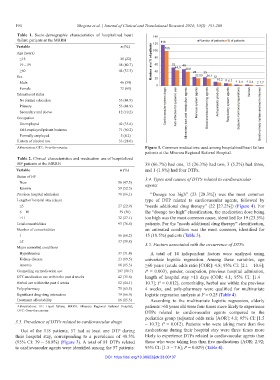
        Abbreviation: OTC: Over-the-counter.                   Figure 1. Common medications used among hospitalized heart failure
                                                               patients at the Mbarara Regional Referral Hospital.
        Table 2. Clinical characteristics and medication use of hospitalized
        HF patients at the MRRH                                38 (66.7%) had one, 15 (26.3%) had two, 3 (5.2%) had three,
        Variable                                    n (%)      and 1 (1.8%) had four DTPs.
        Status of HF                                           3.4. Types and causes of DTPs related to cardiovascular
         New                                       56 (47.5)   agents
         Known                                     59 (52.5)
        Previous hospital admission                78 (66.1)     “Dosage too high” (23 [28.3%]) was the most common
        Length of hospital stay (days)                         type  of DTP related  to cardiovascular  agents,  followed  by
         ≤5                                        27 (22.9)   “needs additional drug therapy” (22 [27.2%]) (Figure 4). For
         6 – 10                                     59 (50)    the “dosage too high” classification, the medication dose being
         ≥11                                       32 (27.1)   too high was the most common cause, identified for 19 (23.5%)
        Total comorbidities                        93 (78.8)   patients. For the “needs additional drug therapy” classification,
        Number of comorbidities                                an  untreated  condition  was  the  most  common,  identified  for
         1                                         56 (60.2)   15 (18.5%) patients (Table 3).
         ≥2                                        37 (39.8)
        Major comorbid conditions                              3.5. Factors associated with the occurrence of DTPs
         Hypertension                              37 (31.4)     A total of 14 independent  factors were analyzed  using
         Kidney disease                            23 (19.5)   univariate  logistic regression.  Among these variables,  age
         Anemia                                    18 (15.3)   ≥60 years (crude odds ratio [COR]: 4.8; 95% CI: [2.1 – 10.6];
        Counseling on medication use               107 (90.7)  P  =  0.003),  gender,  occupation,  previous  hospital  admission,
        OTC medication use within the past 4 weeks  42 (35.6)  length  of  hospital  stay  >11  days  (COR:  4.1;  95%  CI:  [1.4  –
        Herbal use within the past 4 weeks         52 (44.1)   10.7]; P = 0.012), comorbidity, herbal use within the previous
        Poly-pharmacy                              75 (63.5)   4  weeks,  and  poly-pharmacy  were  qualified  for  multivariate
        Significant drug-drug interaction          79 (66.9)   logistic regression analysis at P = 0.25 (Table 4).
        Treatment affordability                    18 (15.3)     According  to  the  multivariate  logistic  regression,  elderly
        Abbreviations:  HF: Heart  failure;  MRRH: Mbarara  Regional  Referral  Hospital;    patients >60 years old were four times more likely to experience
        OTC: Over-the-counter.                                 DTPs related  to cardiovascular  agents  compared  to the
                                                               pediatrics group (adjusted odds ratio [AOR]: 4.1; 95% CI: [1.5
        3.3. Prevalence of DTPs related to cardiovascular drugs  – 10.3]; P = 0.012). Patients who were taking more than five
          Out  of  the  118  patients,  57  had  at  least  one  DTP  during   medications during their hospital stay were three times more
        their hospital stay, corresponding to a prevalence  of 48.3%   likely to experience DTPs related to cardiovascular agents than
        (95% CI: 39 – 56.8%) (Figure 3). A total of 81 DTPs related   those who were taking less than five medications (AOR: 2.92;
        to cardiovascular agents were identified among the 57 patients:   95% CI: [1.5 – 7.6]; P = 0.029) (Table 4).
                                              DOI: https://doi.org/10.36922/jctr.23.00137

