


Page 10 - JCTR-10-5
P. 10
272 Schirato et al. | Journal of Clinical and Translational Research 2024; 10(5): 269-282
2. LF: 0.04 – 0.15 Hz 2.7. Decompression schedules
3. HF: 0.15 – 0.4 Hz
As the size of the time series tends to infinity, the variance All decompression schedules were defined using the ZHL-
and the total power of the spectrum converge to each other, for 16b algorithm, calculated through a script written in R language.
this reason, in the present study, the power of a given power The compartment half-time for nitrogen and helium was set to
spectrum density was approximated by SDNN squared. the original values published by Bühlmann [2]. At the end of
the experiment, maximum supersaturation pressures for each
2.5. Blood samples compartment were adjusted by multiplying the intercept a of the
Venous blood was collected from an antecubital arm vein by a linear equations to limit the compartment j supersaturation for
trained phlebotomist before and after each (simulated) dive. The a given ambient pressure P (in the format P = P amb + a )
following variables were measured: red blood cells, hemoglobin, amb max j bj j
hematocrit, neutrophils, platelets, immunophenotyping, and by 0.85 and 0.65. The factor b was adjusted to calculate stops
j
MPs for quantification through flow cytometry. The samples at 0.20 and 0.45 of the original pressure limits provided by
were collected using Cyto-Chex BCT tubes (Streck, INC, USA). Bühlmann’s values for the deep and shallow decompression
Blood samples were drawn immediately before the profiles, respectively,
experiment and 1 h after the end of decompression. Hemograms Compartment on-gassing and off-gassing were calculated
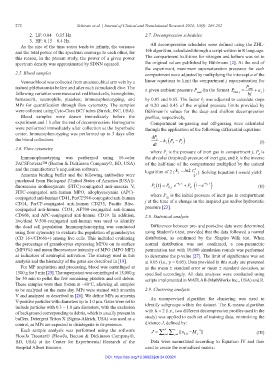
were performed immediately after collection at the hyperbaric through the application of the following differential equation:
center. Immunophenotyping was performed up to 3 days after dP
(
the blood collection. j = kP − P ) (I)
dt j A j
2.6. Flow cytometry
where P is the pressure of inert gas in compartment j, P is
A
j
Immunophenotyping was performed using 16-color the alveolar (inspired) pressure of inert gas, and k is the inverse
j
FACSFortessa™ (Becton & Dickinson Company, BD, USA) of the half-time of the compartment multiplied by the natural
and the manufacturer’s acquisition software. logarithm of 2 ( k = ln 2 t − 1 ). Solving Equation I would yield:
1
Annexin binding buffer and the following antibodies were j 2 j
purchased from Biolegend (United States of America [USA]):
fluorescein isothiocyanate (FITC)-conjugated anti-annexin V, j ( ) = Pt P 0, j e − j + A ( 1− P e −kt j kt ) (II)
FITC-conjugated anti-human MPO, allophycocyanin (APC)- where P is the initial pressure of inert gas in compartment
conjugated anti-human CD41, PerCF594-conjugated anti-human 0,j
CD14, PerCP-conjugated anti-human CD235, Pacific Blue- j at the time of a change in the inspired gas and/or hydrostatic
conjugated anti-human CD31, AF700-conjugated anti-human pressure [23].
CD66b, and APC-conjugated anti-human CD19. In addition, 2.8. Statistical analysis
live/dead V-500-conjugated anti-human was used to identify
the dead cell population. Immunophenotyping was conducted Differences between pre- and post-dive data were determined
using flow cytometry to evaluate the population of granulocytes using Student’s t-test, provided that the data followed a normal
(CD 16+/CD66b+) among live cells. This included evaluating distribution, as confirmed by the Shapiro–Wilk test. When
the percentage of granulocytes expressing MPOs on its surface normal distribution was not confirmed, a non-parametric
(MPO%) and mean fluorescence intensity of MPO (MPO MFI) permutation test with 10,000 simulation rounds was performed
as indicators of neutrophil activation. The strategy used in this to determine the p-value [27]. The limit of significance was set
analysis and the hierarchy of the gates are described in [19]. at 0.05 (i.e., p < 0.05). Data provided in this study are presented
For MP acquisition and processing, blood was centrifuged at as the mean ± standard error or mean ± standard deviation, as
1500 g for 5 min [25]. The supernatant was centrifuged at 15,000 g specified accordingly. All data analyses were conducted using
for 30 min to pellet the few remaining platelets and cell debris. scripts implemented in MATLAB (MathWorks Inc., USA) and R.
These samples were then frozen at −80°C, allowing all samples
to be analyzed on the same day. MPs were stained with annexin 2.9. Clustering analysis
V and analyzed as described in [26]. We define MPs as annexin An unsupervised algorithm for clustering was used to
V-positive particles with diameters up to 1.0 µm. Gates were set to
include particles with 0.3 – 1.0 µm diameters, with the exclusion identify subgroups within the dataset. The K-means algorithm
of background corresponding to debris, which is usually present in with K = 2 (i.e., two different decompression profiles used in the
buffers. Detergent Triton X (Sigma-Aldrich, USA) was used as a study) was applied to each set of training data, minimizing the
control, as MPs are expected to disintegrate in its presence. distance J, defined by:
Each sample analysis was performed using the software J = ∑∑ s || x −M 2 | | (III)
k
FlowJo Treestar (FlowJo, Becton & Dickinson Company, = i 1 = j 1 , kh j
BD, USA) at the Center for Experimental Research of the Data were normalized according to Equation IV and then
Hospital Albert Einstein. used to create the normalized matrix:
DOI: https://doi.org/10.36922/jctr.24.00021

