


Page 11 - JCTR-10-5
P. 11
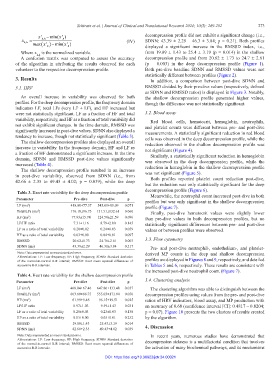
Schirato et al. | Journal of Clinical and Translational Research 2024; 10(5): 269-282   273

                 x ' − min( ' )x                               decompression profile did not exhibit a significant change (i.e.,
                   , kh
          x  , kh    = max (   'x  h ) min( ' )−  h x  h     (IV)  SDNN: 43.39 ± 2.29 – 46.3 ± 3.84; p = 0.21). Both profiles
                                                               from 19.09 ± 1.43 to 25.4 ± 3.19 (p = 0.014) in the shallow
          Where x  is the normalized variable.                 displayed  a  significant  increase  in  the  RMSSD  index,  i.e.,
                 k,h
          A  confusion  matrix  was  computed  to  assess  the  accuracy   decompression profile and from 20.62 ± 1.73 to 24.7 ± 2.61
        of  the  algorithm  in  attributing  the  results  observed  for  each   (p  =  0.003)  in  the  deep  decompression  profile  (Figure  1).
        volunteer to the respective decompression profile.     Both  pre-dive  baseline  SDNN  and  RMSSD  values  were  not
                                                               statistically different between profiles (Figure 2).
        3. Results                                               In  addition,  a  comparison  between  post-dive  SDNN  and
        3.1. HRV                                               RMSSD divided by their pre-dive values (respectively, defined
                                                               as SDNN and RMSSD ratios) is displayed in Figure 3. Notably,
          An  overall  increase  in  variability  was  observed  for  both   the  shallow  decompression  profile  generated  higher  values,
        profiles. For the deep decompression profile, the frequency domain   though the difference was not statistically significant.
        indicators LF, total LFs (very LF + LF), and HF increased but
        were not statistically significant. LF as a fraction of HF and total   3.2. Blood assay
        variability, respectively, and HF as a fraction of total variability did   Red  blood  cells,  hematocrit,  hemoglobin,  neutrophils,
        not exhibit significant changes. In the time domain, RMSSD was   and platelet counts were different between pre- and post-dive
        significantly increased in post-dive values. SDNN also displayed a   measurements. A statistically significant reduction in red blood
        tendency to increase, though not statistically significant (Table 3).  cells was observed in the deep decompression profile, while the
          The shallow decompression profiles also displayed an overall   reduction observed in the shallow decompression profile was
        increase in variability. In the frequency domain, HF and LF as   not significant (Figure 4).
        a fraction of HF demonstrated a significant increase. In the time   Similarly, a statistically significant reduction in hemoglobin
        domain,  SDNN  and  RMSSD  post-dive  values  significantly   was  observed  in  the  deep  decompression  profile,  while  the
        increased (Table 4).                                   reduction in hemoglobin in the shallow decompression profile
          The shallow decompression profile  resulted in an  increase
        in  post-dive  variability,  observed  from  SDNN  (i.e.,  from   was not significant (Figure 5).
                                                                 Both  profiles  reported  platelet  count  reduction  post-dive,
        42.66  ±  2.35  to  49.43  ±  4.02;  p  =  0.039),  while  the  deep
                                                               but the reduction was only statistically significant for the deep
                                                               decompression profile (Figure 6).
        Table 3. Heart rate variability for the deep decompression profile
                                                                 Meanwhile, the neutrophil count increased post-dive in both
        Parameter               Pre‑dive    Post‑dive  p       profiles but was only significant in the shallow decompression
        LF (ms )               418.00±77.37  545.01±89.09  0.071  profile (Figure 7).
             2
        Total LFs (ms )        176.18±96.73  151.51±132.61  0.060  Finally,  post-dive  hematocrit  values  were  slightly  lower
                 2
        HF (ms )                77.93±15.74  124.50±21.59  0.696  than  pre-dive  values  in  both  decompression  profiles,  but  no
             2
        LF/HF ratio             7.31±1.16   8.79±2.00  0.145   statistically significant differences between pre- and post-dive
        LF as a ratio of total variability  0.20±0.02  0.24±0.03  0.059  values or between profiles were observed.
        HF as a ratio of total variability  0.03±0.00  0.04±0.01  0.097
        RMSSD                   20.62±1.73  24.76±2.61  0.003  3.3. Flow cytometry
        SDNN (ms)               43.39±2.29  46.31±3.84  0.217    Pre-  and  post-dive  neutrophil-,  endothelium-,  and  platelet-
        Note: Data arepresented as mean±standard error.        derived  MP  counts  in  the  deep  and  shallow  decompression
        Abbreviations: LF: Low frequency; HF: High frequency; SDNN: Standard deviation
        of  the  normal-to-normal  R-R  interval;  RMSSD:  Root  mean  squared  differences  of   profiles are displayed in Figures 8 and 9, respectively, and detailed
        successive R-R intervals.                              in Tables 5 and 6, respectively. These results are consistent with
                                                               the increased post-dive neutrophil count (Figure 7).
        Table 4. Heart rate variability for the shallow decompression profile
        Parameter               Pre‑dive    Post‑dive  p       3.4. Clustering analysis
        LF (ms )               468.04±67.46  647.86±133.48  0.057  The clustering algorithm was able to distinguish between the
             2
        Total LFs (ms )        663.60±88.75  555.03±171.94  0.050  decompression profiles using values from the pre- and post-dive
                 2
             2
        HF (ms )                61.99±9.46  96.15±19.51  0.025  ratios of HRV indicators, blood assay, and MP production with
        LF/HF ratio             8.97±1.03   9.59±1.43  0.031   an accuracy of 0.68 (confidence interval [CI]: 0.4817 – 0.8204;
        LF as a ratio of total variability  0.25±0.03  0.23±0.03  0.138  p = 0.07). Figure 10 presents the two clusters of results created
        HF as a ratio of total variability  0.03±0.00  0.03±0.01  0.232  by the algorithm.
        RMSSD                   19.09±1.43  25.43±3.19  0.014
        SDNN (ms)               42.66±2.35  49.43±4.02  0.039  4. Discussion
        Note: Data arepresented as mean±standard error.          In  recent  years,  numerous  studies  have  demonstrated  that
        Abbreviations: LF: Low frequency; HF: High frequency; SDNN: Standard deviation   decompression sickness is a multifactorial condition that involves
        of  the  normal-to-normal  R-R  interval;  RMSSD:  Root  mean  squared  differences  of
        successive R-R intervals.                              the activation of many biochemical pathways, and its mechanisms
                                              DOI: https://doi.org/10.36922/jctr.24.00021

