


Page 16 - JCTR-10-5
P. 16
278                       Schirato et al. | Journal of Clinical and Translational Research 2024; 10(5): 269-282
        enhancing the inflammatory process. From this more orthodox   Platelets, once regarded as a thrombus-forming agent, are now
        standpoint, increased neutrophil count and activation would act   recognized  as  primary  players  in  inflammatory  processes.
        as pro-inflammatory agents.                            Activated  platelets  produce  platelet-derived  MPs  that  induce
          However, neutrophils play an anti-inflammatory role in many   neutrophil clustering and further activation [45,61]. Similarly,
        instances.  Neutrophil-derived  MPs  are  potential  inhibitors   endothelial-derived  MPs  induce  neutrophil  adhesion  and
        of  macrophage  activation  [57].  For  instance,  annexin-1-rich   activation  [62].  Therefore,  an  inflammatory  process  can
        neutrophil-derived  MPs  inhibit  neutrophil  activation  [58],   become self-sustaining, as the activation of one cell type leads
        downregulating  an  inflammatory  response.  The  production   to the activation of another, which in turn further activates the
        of  platelet  activation  factors  depends  on  the  neutrophils’   original cell type. In such a setting, an intriguing phenomenon
        state;  it  occurs  when  neutrophils  are  adherent  (i.e.,  under  a   may occur: Despite being activated  and having a tendency
        stimulated condition) but not when they are in suspension [44].   for  neutrophilia,  the  neutrophil  count  might  decrease  due  to
        Neutrophil-derived MPs are not a homogeneous set, and they   migration/sequestration  in  damaged  tissues  [63,64].  In  other
        can induce or inhibit inflammation [59]. Besides this functional   words,  the  inflammatory  condition  might  appear,  without
        diversity, variations in neutrophil counts might lead to different   changes in neutrophil count.
        outcomes. For instance, an increase in neutrophil count seems   Considering HRV as an index of physiological stress from
        to be associated with benign prostate enlargement, whereas a   various sources, our results, along with other reports [18,32],
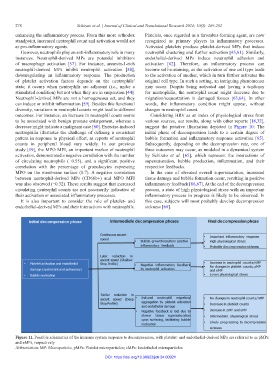
        decrease might indicate a malignant case [60]. Exercise-induced   suggest  the  putative  illustration  depicted  in  Figure  10. The
        neutrophilia  illustrates  the  challenge  of  defining  a  consistent   initial  phase  of  decompression  leads  to  a  certain  degree  of
        pattern in response to physical effort, as reports of neutrophil   bubble  formation  and  inflammatory  response  activation  [65].
        counts  in  peripheral  blood  vary  widely.  In  our  previous   Subsequently,  depending  on  the  decompression  rate,  one  of
        study [19], the MPO MFI, an important marker of neutrophil   three outcomes may occur, as modeled in a dynamical system
        activation, demonstrated a negative correlation with the number   by Schirato  et al.  [65],  which  represent  the  interactions  of
        of  circulating  neutrophils  (−0.55),  and  a  significant  positive   supersaturation,  bubble  production,  inflammation,  and  their
        correlation  with  the  percentage  of  granulocytes  expressing   respective feedbacks.
        MPO  on  the  membrane  surface  (0.7). A  negative  correlation   In  the  case  of  elevated  overall  supersaturation,  increased
        between  neutrophil-derived  MPs  (CD66b+)  and  MPO  MFI   tissue damage and bubble formation occur, resulting in positive
        was also observed (−0.32). These results suggest that increased   inflammatory feedback [66,67]. At the end of the decompression
        circulating neutrophil counts are not necessarily indicative of   process, a state of high physiological stress with an important
        their activation or associated inflammatory processes.  inflammatory process in progress is likely to be observed. In
          It  is  also  important  to  consider  the  role  of  platelet-  and   this case, subjects will most probably develop decompression
        endothelial-derived MPs and their interactions with neutrophils.   sickness [68].


        Figure 11. Possible schematics of the immune system response to decompression, with platelet- and endothelial-derived MPs are referred to as pMPs
        and eMPs, respectively
        Abbreviation: MP: Microparticle; pMPs: Platelet microparticles; eMPs: Endothelial microparticles
                                              DOI: https://doi.org/10.36922/jctr.24.00021

