


Page 51 - JCTR-10-5
P. 51
Arnold and Arm | Journal of Clinical and Translational Research 2024;10(5):307-316   313
        8 weeks of weekly topical PMVT treatments, the defect was   peripheral neuropathy. Vascular changes, including endothelial
        completely filled and 99% epithelialized. After 10 weeks, the   dysfunction,  hyperpermeability,  decreased  blood  flow,  and
        defect  was closed, and PMVT treatment  was discontinued.   tissue hypoxia, can directly result from hyperglycemia. Vascular
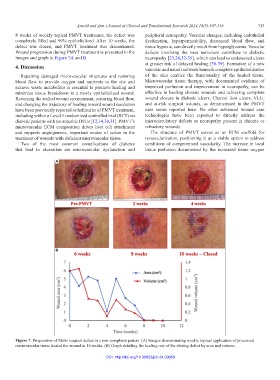
        Wound progression during PMVT treatment is presented in the   defects  involving  the  vasa  nervorum  contribute  to  diabetic
        images and graph in Figure 7A and B.                   neuropathy [23,26,32-35], which can lead to undetected ulcers
                                                               at greater risk of delayed healing [36-39]. Formation of a new
        4. Discussion                                          vascular and neural network beneath complete epithelialization
          Repairing  damaged microvascular structures and restoring   of the skin enables the functionality of the healed tissue.
        blood  flow  to  provide  oxygen  and  nutrients  to  the  site  and   Microvascular tissue therapy, with documented evidence of
        remove waste metabolites is essential to promote healing and   improved perfusion and improvement in neuropathy, can be
        minimize  tissue breakdown in a newly epithelialized  wound.   effective in healing chronic wounds and achieving complete
        Reversing the stalled wound environment, restoring blood flow,   wound closure in diabetic ulcers, Charcot foot ulcers, VLU,
        and changing the trajectory of healing toward wound resolution   and at-risk surgical wounds, as demonstrated in the PMVT
        have been previously reported as hallmarks of PMVT treatment,   case series reported here. No other advanced wound care
        including within a Level 1 randomized controlled trial (RCT) on   technologies have been reported to directly address the
        diabetic patients with neuropathic DFUs [12,14,30,31]. PMVT’s   microcirculatory defects or neuropathy present in chronic or
        microvascular  ECM composition drives  host cell  attachment   refractory wounds.
        and  supports angiogenesis,  important  modes  of  action  in  the   The structure of PMVT serves as an ECM scaffold for
        treatment of wounds with deficient microvascular tissue.  revascularization, positioning it as a viable option to address
          Two of the most common  complications  of diabetes   conditions of compromised vascularity. The increase in local
        that  lead  to ulceration  are  microvascular  dysfunction  and   tissue perfusion documented  by the  increased  tissue  oxygen

                         A


                         B


        Figure 7. Progression of Mohs surgical defect in a non-compliant patient. (A) Images demonstrating weekly topical application of processed
        microvascular tissue healed the wound in 10 weeks. (B) Graph detailing the healing rate of the closing defect by area and volume.

                                               DOI: http://doi.org/10.36922/jctr.24.00059

