


Page 49 - JCTR-10-5
P. 49
Arnold and Arm | Journal of Clinical and Translational Research 2024;10(5):307-316   311
          In this case, a 65-year-old male  presented with a poorly   28% of global chronic wounds that require treatment, accounting
        granulated  1  cm  left  plantar  Charcot  DFU.  The wound had   for nearly  $2 billion  in annual  expenditures,  representing  an
                     2
        been open for more than 1 year despite standard care, including   enormous and growing global  problem  [28]. Up to 60% of
        serial debridement, negative pressure wound therapy (NPWT),   VLUs  are considered chronic because they persist for more
        and total contact casting. The lesion extended 0.4 cm deep to   than 6 weeks, usually as a result of blood circulation problems.
        devitalized bone, and the patient was being treated concurrently   Obesity, smoking, deep vein thrombosis (DVT), varicose veins,
        for chronic  osteomyelitis  on presentation  and  initiation  of   previous leg injury or surgery, age, and diabetes  are all  risk
        PMVT  treatment.  Between  2  and  4  weeks,  offloading  non-  factors that can contribute to the development of a VLU [28].
        compliance  led to re-emergence  of infection,  requiring   As PMVT is intended to improve blood flow through the repair
        significant debridement and initiation of antibiotics. Following   and  reconstruction  of microvascular  tissue  by serving  as a
        this, the wound area was now 24 cm . Despite this setback, after   scaffold for cellular invasion and capillary growth, the benefits
                                    2
        three  additional  PMVT  applications,  the  wound had  become   of improved microcirculatory blood flow may be particularly
        99% epithelialized, and PMVT treatment  was discontinued.   impactful on patients with compromised microvasculature, such
        The ulcer went on to fully close within 6 additional  weeks   as patients with increased risk for non-healing VLUs.
        with standard care and has remained healed 6 months to date   The 64-year-old male with a history of chronic kidney disease
        following closure. Images of the ulcer progression and the   (Stage 3b), hypertension, chronic DVT, Leiden Factor V, and
        wound area/volume graph are displayed in Figure 3A and B.  asthma, who presented with a left VLU in August 2021, is an
                                                               example of such a patient. The ulcer worsened following DVT in
        3.3. Case 3: Increasing blood flow using PMVT to treat a   April 2022. No thrombectomy interventions were advisable due
        chronic venous leg ulcer
                                                               to an unacceptably high risk of complications. Multiple topical
          Venous leg ulcers (VLUs), among the most common types of   wound management products, including silver alginate, foam,
        lower extremity wounds, are open ulcers that frequently occur   hydroconductive  and other composite dressings, cadexomer
        on the inside of the leg above the ankle. VLUs comprise about   iodine, topical antibiotics, and an ECM xenograft, along with
                                                               compression  wraps  (the  patient’s  job  requires  standing  8  h  a
                                                               day), all failed to close the VLU.
         A
                                                                 In January 2024, after nearly 2.5  years of not healing, the
                                                               patient received his first treatment of PMVT. The PMVT disk was
                                                               removed from the vial and applied directly onto the surface of the
                                                               ulcer after very minimal selective debridement. On contact with
                                                               blood at the wound site, the PMVT graft was quickly absorbed
                                                               into the surrounding tissue. Two additional PMVT applications
                                                               were made at weeks 1 and 5 after the initial treatment. A non-
                                                               adherent dressing (Mepitel; Mölnlycke Health Care, USA) was
                                                               used to cover 1 – 2 cm beyond the ulcer’s edges after each PMVT
                                                               application.  The  VLU was covered further by a compression
                                                               bandage (initially an alginate-based  absorbent  compress  for
         B                                                     the  first  two  treatments,  then  Coban  2  Lite  [3M  Healthcare,
                                                               USA] for the final application). The patient suffered a right hip
                                                               fracture requiring surgery and hospitalization 2 weeks after initial
                                                               treatment and had limited transportation means for further follow-
                                                               up visits until week 6, resulting in a gap between the second and
                                                               third PMVT applications. As with the other cases, the VLU was
                                                               visually examined and photographed at each visit, and the wound
                                                               size was measured using a ruler. In addition, tissue oxygenation
                                                               was assessed using a point-of-care near-infrared (NIR) imaging
                                                               device (Snapshot NIR; Kent Imaging, Canada).
                                                                 The  ulcer  closed  after  just  three  applications  of  PMVT.
                                                               Images of the VLU’s progression are displayed in Figure 4A,
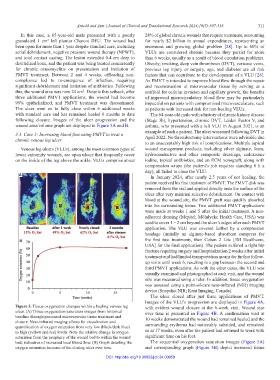
        Figure 5. Tissue oxygenation changes within a healing venous leg   with evident wound closure at the 6-week visit.  Wound size
        ulcer. (A) Tissue oxygenation saturation images from historical   over time  is presented  in  Figure  4B. A  confirmation  visit  at
        baseline through processed microvascular tissue treatment and   10 weeks demonstrated the wound had remained healed and the
        closure. Near-infrared imaging allows for visualization and
        quantification of oxygen saturation from very low (black/dark blue)   surrounding erythema had noticeably subsided, and remained
        to high (yellow and red) levels. Note the relative change in oxygen   so at 17 weeks, even after the patient had returned to work with
        saturation from the periphery of the wound bed to within the wound   significant time on his feet.
        bed, indicative of increased local blood flow. (B) Graph detailing the   The  sequential  oxygenation  saturation  images  (Figure  5A)
        oxygen saturation increase of the closing ulcer over time.  and corresponding  graph (Figure  5B) depict  increased tissue
                                               DOI: http://doi.org/10.36922/jctr.24.00059

