


Page 50 - JCTR-10-5
P. 50
312                       Arnold and Arm | Journal of Clinical and Translational Research 2024;10(5):307-316
        oxygenation within the center region of the wound area from the   surgical skin defect to be at greater risk for not healing. In such
        historical baseline (13%), after initial PMVT treatment (49%),   cases, proactive use of an advanced wound care treatment may
        through healing just before closure (62%), and maintained   be warranted.
        following closure (61%). Although these numbers are relative,   The  first  Mohs  patient,  a  51-year-old  male  with  coronary
        the increased oxygen saturation  represents improved  blood   artery  disease,  hypertension,  nicotine  dependence,  and  post-
        flow and is indicative of the transition to the proliferative and   COVID  pulmonary  issues, had undergone Mohs excision  of
        remodeling phases of healing within the wound area.    a basal cell carcinoma on his right scapula. Initial attempts to
          By repairing the deficient local microvasculature around the   close the defect using standard treatment and negative pressure
        VLU, PMVT was able  to assist with the  delivery  of oxygen   wound therapy were unsuccessful, and he presented 5 weeks
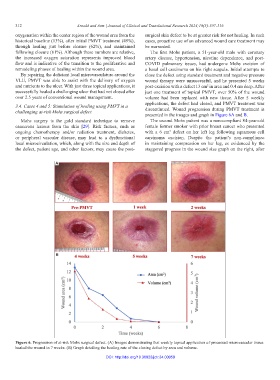
        and nutrients to the ulcer. With just three topical applications, it   post-excision with a defect 13 cm  in area and 0.4 cm deep. After
                                                                                         2
        successfully healed a challenging ulcer that had not closed after   just one treatment of topical PMVT, over 50% of the wound
        over 2.5 years of conventional wound management.       volume had been replaced  with new tissue.  After 5  weekly
                                                               applications, the defect had closed, and PMVT treatment was
        3.4. Cases 4 and 5: Stimulation of healing using PMVT in a   discontinued.  Wound progression during  PMVT treatment  is
        challenging at-risk Mohs surgical defect
                                                               presented in the images and graph in Figure 6A and B.
          Mohs surgery  is the  gold  standard  technique  to  remove   The second Mohs patient was a non-compliant 84-year-old
        cancerous lesions from the skin [29]. Risk factors, such as   female former smoker with prior breast cancer who presented
        ongoing chemotherapy  and/or  radiation  treatment,  diabetes,   with a 6 cm  defect  on her left leg following squamous cell
                                                                         2
        or  peripheral  vascular  disease,  may  lead  to  a  dysfunctional   carcinoma  excision.  Despite  the  patient’s  non-compliance
        local microcirculation, which, along with the size and depth of   in maintaining  compression on her leg, as evidenced  by the
        the defect, patient age, and other factors, may cause the post-  staggered progress in the wound size graph on the right, after


                         A


                         B


        Figure 6. Progression of at-risk Mohs surgical defect. (A) Images demonstrating that weekly topical application of processed microvascular tissue
        healed the wound in 7 weeks. (B) Graph detailing the healing rate of the closing defect by area and volume.
                                               DOI: http://doi.org/10.36922/jctr.24.00059

