


Page 43 - JCTR-10-6
P. 43
Aminizadeh et al. | Journal of Clinical and Translational Research 2024; 10(6): 348-356   353
                                                               has a protective effect on the mitochondrial genome in muscle
                                                               tissue post-exercise. In another study on human NP cells, they
                                                               showed that  administration  of MitoQ decreased  apoptosis
                                                               and  the  expression  of  DRP1  and  FIS1  while  increasing  the
                                                               expression of proteins involved in fusion [42]. In our study,
                                                               the administration of MitoQ neutralized the enhancing effects
                                                               of ET on fusion, and in addition, in the  rats that  performed
                                                               HIIT exercise, it enhanced fission by increasing the expression
                                                               of DRP1 protein (in the HIIT + MitoQ group). These findings
                                                               contradict the previous studies where MitoQ had no effect in
                                                               the groups that performed exercise [42]. Given that exercise,
                                                               particularly  aerobic  exercise  influences  the  mitochondria  and
                                                               MitoQ specifically targets the mitochondria, the results in the
                                                               ET + MitoQ and HIIT + MitoQ groups should align  more
                                                               closely with predictions. Despite the contradiction with other
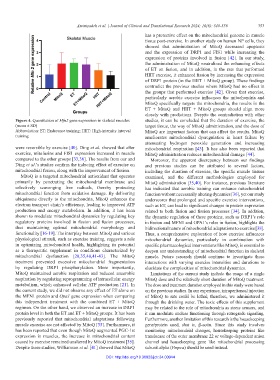
        Figure 4. Quantitation of Mfn2 gene expression in skeletal muscles   studies, it can be concluded that the duration of exercise, the
        (mean ± SD)                                            target tissue, the way of MitoQ administration, and the dose of
        Abbreviation: ET: Endurance training; HIIT: High-intensity interval   MitoQ are important factors that can affect the results. MitoQ
        training                                               ameliorates  mitochondrial  dysregulation  in heart failure  by
                                                               attenuating  hydrogen peroxide generation  and increasing
        were reversible by exercise [40]. Ding et al. showed that after   mitochondrial  respiration  [43]. It has also been reported  that
        exercise, mitofusins and FIS1 expression increased in muscle   MitoQ administration reduces mitochondrial damage [44].
        compared to the other groups [33,38]. The results from our and   Moreover,  the  apparent  discrepancy  between  our  findings
        Ding et al.’s studies confirm the inducing effect of exercise on   and previous studies can be attributed to several factors,
        mitochondrial fusion, along with the improvement of fission.  including the duration of exercise, the specific muscle tissues
          MitoQ is a targeted mitochondrial antioxidant that operates   examined, and the different methodologies employed for
        primarily  by  penetrating  the  mitochondrial  membrane  and   MitoQ administration [35,40]. For instance, previous literature
        selectively  scavenging free radicals, thereby protecting   has indicated that aerobic training can enhance mitochondrial
        mitochondrial function from oxidative damage. By delivering   function without necessarily altering dynamics [36], yet our study
        ubiquinone directly to the mitochondria, MitoQ enhances the   underscores that prolonged and specific exercise interventions,
        electron transport chain’s efficiency, leading to improved ATP   such as ET, can lead to significant changes in protein expression
        production and energy metabolism. In addition,  it has been   related  to  both  fusion  and  fission  processes  [34]. In addition,
        shown to modulate mitochondrial dynamics by regulating key   the dynamic regulation of these proteins, such as DRP1’s role
        regulatory  proteins  involved  in  fission  and  fusion  processes,   in fission and MFN1 and OPA1’s roles in fusion, highlights the
        thus maintaining optimal  mitochondrial  morphology and   bidirectional nature of mitochondrial adaptations to exercise [38].
        functionality [16-19]. The interplay between MitoQ and various   Thus, a comprehensive exploration of how exercise influences
        physiological stimuli, such as exercise training, suggests a role   mitochondrial dynamics, particularly in combination with
        in  optimizing  mitochondrial  health,  highlighting  its  potential   specific pharmacological interventions like MitoQ, is essential to
        as a therapeutic  supplement  in  conditions  characterized  by   deepen our understanding of mitochondrial function in skeletal
        mitochondrial  dysfunction  [20,35,40,41-43]. The  MitoQ   muscle.  Future  research  should  continue  to  investigate  these
        treatment  prevented  excessive  mitochondrial  fragmentation   interactions with varying exercise intensities and durations to
        by  regulating  DRP1  phosphorylation.  More  importantly,   elucidate the complexities of mitochondrial dynamics.
        MitoQ maintained aerobic  respiration  and reduced  anaerobic   Limitations of the current study include the usage of a single
        respiration by regulating reprogramming of intracellular energy   MitoQ dose and the relatively short duration of MitoQ treatment.
        metabolism, which enhanced cellular ATP production [21]. In   The dose and treatment duration employed in this study were based
        the current study, we did not observe any effect of ET alone on   on the previous studies. In our experience, intraperitoneal injection
        the MFN1 protein and Opa1 gene expression when comparing   of  MitoQ  to  rats  could  be  lethal;  therefore,  we  administered  it
        this independent treatment  with the  combined  ET + MitoQ   through the drinking water. The toxic effects of this supplement
        regimen. On the other hand, we observed an increase in DRP1   may be related to the role of mitochondria as stress sensors, and
        protein level in both the ET and ET + MitoQ groups. It has been   it can modulate nuclear functioning through retrograde signaling.
        previously reported that mitochondrial adaptations  following   Furthermore, another limitation of this research is the housekeeping
        muscle exercise are not affected by MitoQ [35]. Furthermore, it   gene/protein  used,  that is,  β-actin. Since this study involves
        has been reported that even though MitoQ augmented PGC-1α   monitoring  mitochondrial  changes,  housekeeping  proteins  like
        expression in muscles, the increase  in mitochondrial  content   translocase of the outer membrane 22 or voltage-dependent anion
        caused by exercise remained unaltered by MitoQ treatment [35].   channel and housekeeping gene like mitochondrial processing
        Despite these studies, Williamson et al. [41] showed that MitoQ   subunit alpha (Pmpca) should be used instead.

                                               DOI: http://doi.org/10.36922/jctr.24.00044

