


Page 96 - JCTR-11-2
P. 96
Journal of Clinical and
            Translational Research                                        Biomimetic matrix used to treat diabetic foot ulcers


            a higher percent closure rate than patients 1, who received   Although not intended to be part of our analysis, the
            a lower number of BMM applications.                outcomes from our initial patient cohort are of value added.
              The treatment length ranged from 5 to 11 weeks, with one   The initial eight wounds showed significant progress for
            patient achieving full wound closure at 6 weeks following   most part of the study. The wound of patient 1 closed
            a single application of BMM. In this cohort of patients   by week 14, remained closed for 5 weeks, briefly opened
            treated with BMM, a reduction in inflammation followed   for a week, and then closed again. This wound remained
                                                               closed for >3 months. The wounds of patients 2, 3, and 8
            by the presence of granulation tissue was observed early   closed completely in 8 – 9 weeks and remained closed for
            in the healing process. This was followed by maturation   >3 months. The wound of patient 4 closed at week 11 and
            of the granulation tissue leading to re-epithelialization.   remained closed for >3 months. For patient 5, the wound
            Furthermore, odor and drainage were noticeably improved   remained open still, even after the wound had decreased
            with BMM treatment.
                                                               further  in  the  area  to  13  cm ,  and  thus  the  patient  was
                                                                                       2
              No adverse effects were observed during the treatment   subsequently scheduled for vascular intervention. Patient
            with BMM, and the product was well-tolerated by all   6’s wound was closed at week 6 and remained closed for
            subjects in this study. This is particularly important   >3 months. For patient 7, the wound area reduced to 3.5 cm
                                                                                                             2
            given the concern around potential immunogenicity and   but then expanded again; this patient was lost to follow-up.
            skin  reactions  associated  with  certain  peptides.   BMM
                                                   10
            has been subjected to extensive safety testing including   4. Discussion
            sensitization and skin irritation studies using relevant   In this clinical series, chronic, stalled diabetic lower
            animal models as well as human subjects under “worst-  extremity wounds were treated with a novel, FDA-approved
            case” conditions. As a result, BMM has been approved as a   BMM. Besides diabetes, all patients presented multiple
            non-sensitizer and non-irritant by the U.S. Food and Drug   comorbidities that can negatively impair wound
            Administration (FDA). In this small case series study, no   healing, such as neuropathy, peripheral vascular disease,
            signs of inflammation or irritation were observed, and, in   osteomyelitis, and prior partial amputation. Nearly
            fact, an improvement in the peri-wound skin appearance   all  wounds  were present for over a  year without  any
            was noted.                                         progression toward healing despite the use of a variety
              The number of BMM applications, duration of      of biologics, including living cell products, collagen,
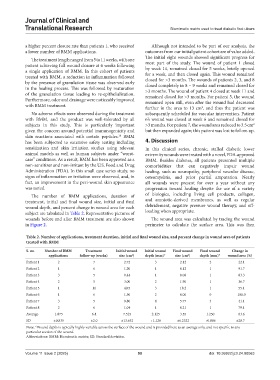
            treatment, initial and final wound size, initial and final   and amniotic-derived membranes, as well as regular
            wound depth, and percent change in wound area for each   debridement, negative pressure wound therapy, and off-
            subject are tabulated in Table 2. Representative pictures of   loading when appropriate.
            wounds before and after BMM treatment are also shown   The wound area was calculated by tracing the wound
            in Figure 2.                                       perimeter to calculate the surface area. This was then

            Table 2. Number of applications, treatment duration, initial and final wound size, and percent change in wound area of patients
            treated with BMM
            S. no.  Number of BMM    Treatment    Initial wound   Initial wound   Final wound   Final wound   Change in
                                                                                 2
                                                         2
                      applications  follow‑up (weeks)  size (cm )  depth (mm)*  size (cm )  depth (mm)*  wound area (%)
            Patient 1     2              7            2.72         3          2.12        2          −22.1
            Patient 2     1              6            1.20         1          0.12        1          −91.7
            Patient 3     3              5            0.44         1          0.08        1          −83.3
            Patient 4     2              5            3.00         2          1.90        1          −36.7
            Patient 5     1             11            40.5         3          18.2        1          −55.1
            Patient 6     1              6            1.50         2          0.00        0          −100.0
            Patient 7     3              5            9.80         4          5.77        3          −41.1
            Patient 8     2              6            1.04         1          0.21        1          −79.1
            Average     1.875           6.4          7.525        2.125       3.55       1.250       −63.6
            SD          ±0.835          ±2.0         ±13.652     +1.126     ±6.2322     +0.886       ±28.7
            Note: *Wound depth is typically highly variable across the surface of the wound and is provided here as an average only, and not specific to any
            particular section of the wound.
            Abbreviations: BMM: Biomimetic matrix; SD: Standard deviation.


            Volume 11 Issue 2 (2025)                        90                            doi: 10.36922/jctr.24.00063

