


Page 97 - JCTR-11-2
P. 97
Journal of Clinical and
            Translational Research                                        Biomimetic matrix used to treat diabetic foot ulcers


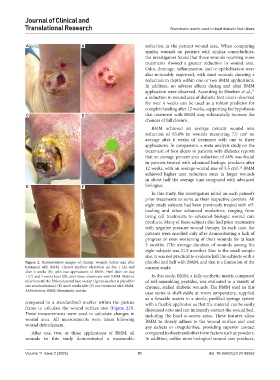
            A                       B                          reduction in the percent wound area. When  comparing
                                                               similar wounds on patients with similar comorbidities,
                                                               the investigators found that those wounds receiving more
                                                               treatments showed a greater reduction in wound area.
                                                               Odor, drainage, inflammation, and re-epithelization were
                                                               also noticeably improved, with most wounds showing a
                                                               reduction in depth within one or two BMM applications.
                                                               In addition, no adverse effects during and after BMM
                                                               application were observed. According to Sheehan et al.,
                                                                                                            11
                                                               a reduction in wound area of diabetic foot ulcers observed
                                                               for over 4  weeks can be used as a robust predictor for
                                                               complete healing after 12 weeks, supporting the hypothesis
            C                       D                          that treatment with BMM may substantially increase the
                                                               chances of full closure.
                                                                 BMM achieved an average percent wound area
                                                               reduction of 63.6% in wounds measuring 7.5 cm  on
                                                                                                          2
                                                               average  after  6  weeks  of  treatment  with  one  to  three
                                                               applications. In comparison, a meta-analysis study on the
                                                               treatment of foot ulcers in patients with diabetes reports
                                                               that an average percent area reduction of 48% was found
                                                               in patients treated with advanced biologic products after
                                                               12 weeks, with an average wound size of 3.5 cm .  BMM
                                                                                                      2 12
                                                               achieved higher area reduction rates in larger wounds
                                                               in about half the average time compared with advanced
            E                       F                          biologics.
                                                                 In this study, the investigators relied on each patient’s
                                                               prior treatments to serve as their respective controls. All
                                                               eight study subjects had been previously treated with off-
                                                               loading and other advanced modalities, ranging from
                                                               living cell treatments to advanced biologic wound care
                                                               products. Many of these subjects also had prior treatments
                                                               with negative pressure wound therapy. In each case, the
                                                               patients were enrolled only after demonstrating a lack of
                                                               progress or even worsening of their wounds for at least
                                                               3  months. (The average duration of wounds among the
                                                               eight subjects was 21.5 months). Due to the small sample
                                                               size, it was not practical to evaluate half the subjects with a
            Figure  2.  Representative images of chronic wounds before and after   placebo and half with BMM, and that is a limitation of the
            treatment with BMM. Charcot midfoot ulceration on day 1 (A) and   current study.
            after 6  weeks (B), with two applications of BMM. Heel ulcer on day
            1 (C) and 5 weeks later (D), after three treatments with BMM. Midfoot   In this study, BMM, a fully synthetic matrix composed
            ulcer beneath the fifth metatarsal base on day 1 (green marker is placed for   of self-assembling peptides, was evaluated in a variety of
            size standardization) (E) and 6 weeks after (F) one treatment with BMM.  chronic, stalled diabetic wounds. The BMM used in this
            Abbreviation: BMM: Biomimetic matrix.
                                                               case series is shelf-stable at room temperature, supplied
                                                               as a flowable matrix in a sterile, prefilled syringe system
            compared to a standardized marker within the picture   with a flexible applicator so that the material can be easily
            frame to calculate the wound surface area (Figure  2D).   dispensed onto and can intimately contact the wound bed,
            These measurements were used to calculate changes in   including the hard-to-access areas. These features allow
            wound area. All measurements were taken following   BMM to closely adhere to the wound surface and coat
            wound debridement.                                 any defects or irregularities, providing superior contact
              After one, two, or three applications of BMM, all   compared to sheets and other form factors such as powders.
            wounds in this study demonstrated a measurable     In addition, unlike most biological wound care products,


            Volume 11 Issue 2 (2025)                        91                            doi: 10.36922/jctr.24.00063

