


Page 80 - JCTR-11-3
P. 80
Journal of Clinical and
            Translational Research                                                Outcomes of placenta previa with APH


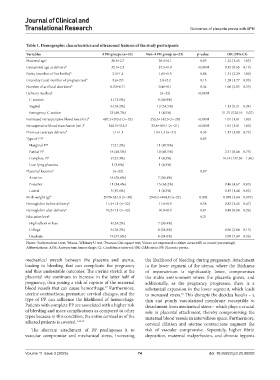
            Table 1. Demographic characteristics and ultrasound features of the study participants

            Variables                       APH groups (n=33)  Non‑APH group (n=23)  p‑value      OR (95% CI)
            Maternal age a                      30.6±2.7             28.4±4.1         0.03       1.22 (1.45 – 1.03)
            Gestational age at delivery b       35.5±2.3             37.5±1.0        <0.0001     0.35 (0.65 – 0.19)
            Parity (number of live births) b     2.3±1.4             1.61±1.3         0.06       1.51 (2.29 – 1.00)
            Gravidity (total number of pregnancies) b  3.6±2.0       2.8±2.2          0.15       1.29 (1.77 – 0.93)
            Number of artificial abortions b    0.52±0.71            0.48±0.1         0.34       1.06 (2.03 – 0.55)
            Delivery method c                                        (n=22)          <0.0001
             C-section                          4 (12.1%)           9 (40.9%)
             Vaginal                            6 (18.2%)           12 (54.5%)                   1.13 (5.21 – 0.24)
             Emergency C-section                23 (69.7%)           1 (4.5%)                   51.75 (528.10 – 5.07)
            Estimated intraoperative blood loss (mL) b  487.2±213.6 (n=32)  253.5±142.3 (n=20)  <0.0001  1.01 (1.01 – 1.00)
            Intraoperative blood transfusion (mL) b  348.5±318.3  23.8±109.1 (n=21)  <0.0001     1.01 (1.01 – 1.00)
            Previous cesarean delivery b         1.1±1.1          1.0±1.3 (n=21)      0.33       1.17 (1.88 – 0.73)
            Type of PP c                                                              0.03
             Marginal PP                        7 (21.2%)           11 (47.8%)
             Partial PP                         16 (48.5%)          10 (43.5%)                   2.51 (8.64 – 0.73)
             Complete PP                        9 (27.3%)            1 (4.3%)                   14.14 (137.30 – 1.46)
             Low-lying placenta                 1 (3.0%)             1 (4.3%)                         -
            Placental location c                 (n=32)                               0.07
             Anterior                           16 (50.0%)          7 (30.4%)
             Posterior                          11 (34.4%)          15 (65.2%)                   0.46 (4.67 – 0.05)
             Lateral                            5 (15.6%)            1 (4.3%)                    0.15 (1.44 – 0.02)
            Birth weight (g) b               2570±531.8 (n=30)   2945.5±444.8 (n=22)  0.002     0.998 (1.00 – 0.997)
            Hemoglobin before delivery b      11.4±1.1 (n=32)        11.6±0.9         0.58       0.83 (1.45 – 0.47)
            Hemoglobin after delivery a       10.2±1.1 (n=32)        10.9±0.9         0.01       0.48 (0.88 – 0.26)
            Education level c                                                         0.21
             High school or less                8 (24.2%)           7 (30.4%)
             College                            6 (18.2%)           8 (34.8%)                    0.66 (2.84 – 0.15)
             Graduate                           19 (57.6%)          8 (34.8%)                    2.08 (7.69 – 0.56)
                              b
                                             c
                 a
            Notes:  Independent t-test,  Mann–Whitney U test,  Pearson Chi-square test; Values are expressed as either mean±SD or count (percentage).
            Abbreviations: APH: Antepartum hemorrhage; CI: Confidence interval; OR: Odds ratio; PP: Placenta previa.
            mechanical stretch between the placenta and uterus,   the likelihood of bleeding during pregnancy. Attachment
            leading to bleeding that can complicate the pregnancy   to the lower segment of the uterus, where the thickness
            and thus undesirable outcomes. The uterine stretch at the   of myometrium is significantly lower, compromises
            placental site continues to increase in the latter  half of   the stable environment where the placenta grows, and
            pregnancy, thus posing a risk of rupture of the maternal   additionally, as the pregnancy progresses, there is a
                                              17
            blood vessels that can cause hemorrhage.  Furthermore,   substantial expansion in the lower segment, which leads
            uterine contractions, premature cervical changes, and the   to increased stress.  This disrupts the decidua basalis – a
                                                                              16
            type of PP can influence the likelihood of hemorrhage.   thin and poorly vascularized membrane susceptible to
            Patients with complete PP are associated with a higher risk   detachment from mechanical stress – which plays a crucial
            of bleeding and more complications as compared to other   role  in placental  attachment,  thereby  compromising  the
            types because in this condition, the entire cervical os of the   maternal blood vessels in intervillous space. Furthermore,
            affected patients is covered. 1,13,17              cervical dilation and uterine contractions augment the
              The aberrant attachment of PP predisposes it to   risk of vascular compromise. Separately, higher fibrin
            vascular compromise and mechanical stress, increasing   deposition, maternal malperfusion, and chronic hypoxia


            Volume 11 Issue 3 (2025)                        74                            doi: 10.36922/jctr.25.00002

